
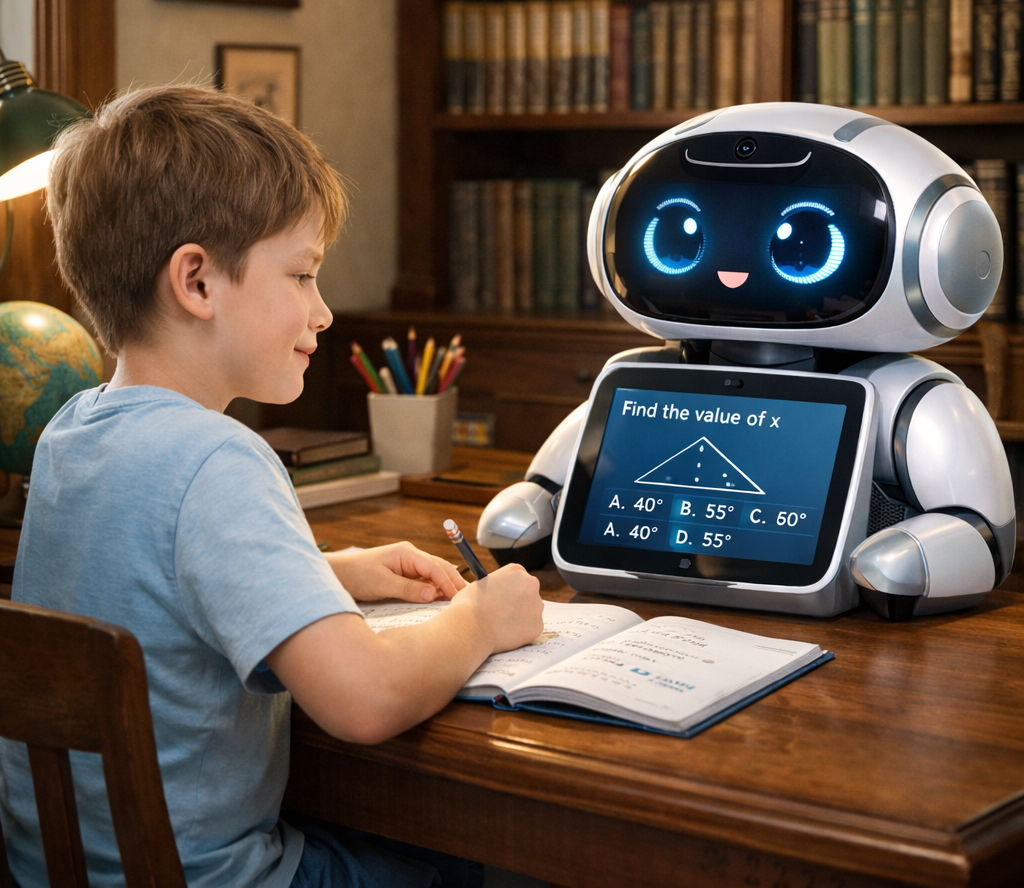
When Reasoning and Memory Break Through:
Why AI Companion Tutor Robots Will Redefine Home Education
Introduction
At the 2026 World Economic Forum in Davos, two statements quietly reshaped how many of us should think about AI’s next embodiment.
Demis Hassabis emphasized that future AI systems will not just “answer questions,” but build persistent world models and long-term memory, enabling them to reason across time rather than across prompts.
Dario Amodei, meanwhile, highlighted that the real scaling challenge of large language models(LLMs) is no longer raw intelligence, but alignment, reliability, and sustained interaction with humans in real environments.
Taken together, these perspectives point to a clear conclusion:
The most meaningful frontier for LLMs is not another chatbot—but a long-term, physically or semi-physically embodied companion.
This is where accompany robots, especially AI-powered companion tutor robots for home education, become strategically inevitable rather than conceptually experimental.
In reality, most solutions—from homework apps to AI tutors—remain task-based tools, not true educational partners. That limitation is not accidental. It is structural.
Once these constraints are meaningfully lifted, a new product category becomes inevitable:
the long-term AI companion tutor—most naturally embodied as an intelligent robot.
The Ceiling of Today’s Education Apps
Platforms like Homework Help apps and online tutoring tools are effective within a narrow scope, but they share the same structural boundaries:
1. Reasoning Is Local, Not Cognitive
Most systems can:
lSolve a problem
lExplain a method
But they cannot:
lDiagnose why a student consistently fails
lModel a learner’s cognitive gaps across topics
lAdapt teaching strategy based on thinking patterns
They operate on problem-level reasoning, not learner-level reasoning.
2. Memory Is Shallow and Non-Personalized
Current systems:
lDo not remember a learner’s struggles over months
lDo not build a persistent ability profile
lDo not evolve their teaching behavior over time
The learner is treated as a session, not a growing individual.
3. Learning Is Reactive, Not Guided
Students trigger interaction by asking questions.
The system rarely asks:
lWhat should you learn next?
lWhy is this concept foundational for you?
lShould we slow down, or rebuild understanding?
This is why these tools feel like utilities, not educators.
What Changes When Reasoning and Memory Break Through
From Answering Questions → Diagnosing Understanding
With advanced reasoning, AI systems can move beyond correctness and into cognitive diagnosis:
lIdentifying misconception types
lRecognizing flawed reasoning paths
lAdapting explanations based on how a learner thinks
This is not about being “smarter at math.”
It is about acquiring pedagogical intelligence.
From Stateless Tools → Persistent Learning Companions
Long-term memory allows AI to:
lRemember learning trajectories across months
lTrack emotional and motivational patterns
lAdjust teaching style based on learner preferences
At this point, the AI stops being a tool and starts becoming a learning counterpart.
Different students experience fundamentally different “personalities” from the same system.
Reasoning + Memory = A New Educational Entity
When these two capabilities converge, the product is no longer an app feature.
It becomes:
lProactive
lContext-aware
lDevelopment-oriented
lRelationship-based
This is the birth of the AI companion tutor.
Why Embodiment Matters: From Software to Companion Robots
A critical implication is often overlooked: A long-term companion intelligence cannot remain purely software-based.
Even with perfect AI models, mobile apps face three inherent limitations:
lWeak presence
lConstant attention competition
lDisconnection from daily life rhythms
A physical AI companion robot changes this dynamic:
|
Dimension |
App-based Tutor |
Companion Tutor Robot |
|
Presence |
On-demand |
Continuous |
|
Attention |
Competing |
Dedicated |
|
Context |
Screen-based |
Life-integrated |
|
Trust |
Tool |
Role |
|
Relationship |
Transactional |
Long-term |
This is why AI breakthroughs will naturally drive demand for embodied educational robots, not the other way around.
The Rise of Companion Tutor Robots in Home Education
Home education is where this shift becomes most powerful.
Parents face a structural dilemma:
lLimited time
lInconsistent supervision
lDifficulty sustaining learning discipline
Companion tutor robots fill this gap by providing:
lDaily learning routines
lStep-by-step guidance
lPersonalized review
lEmotional stabilization
lGentle behavioral nudging
They do not replace parents.
They stabilize the learning environment.
From Teaching Tools to Educational Infrastructure
The most important shift is conceptual.
Traditional education products optimize for:
lQuestion accuracy
lContent coverage
lShort-term performance
AI companion tutor robots optimize for:
lCognitive development
lLearning habits
lEmotional resilience
lLong-term ability growth
They act as educational infrastructure, not content services.
Why This Will Structurally Outpace Existing Platforms
The competitive advantage will no longer be:
lQuestion databases
lUser scale
lMarketing reach
The new moat will be:
lLongitudinal learning memory
lCognitive modeling capability
lAdaptive pedagogy engines
lFamily-level trust integration
These are closer to AI system architecture challenges than traditional education platform problems.
The Real Early Adoption Window
Contrary to common belief, the first large-scale impact will not be exam preparation.
It will emerge in:
lPrimary education
lEarly cognitive development
lLearning habit formation
lHome-based companion tutoring
This is where:
lAttention matters most
lHuman supervision is most constrained
lLong-term value compounds
Final Insight for Subscribers
When AI breaks through reasoning and long-term memory, education products will shift from “answer providers” to “learning companions.”
And learning companions, by nature, require presence, continuity, and embodiment.
AI companion tutor robots are not an incremental upgrade.
They represent a product paradigm shift in how education support is delivered at home.
The question is no longer if this category will emerge—
but who will design it responsibly, and who will earn long-term trust.
Contact Xyserrobotics experts to deploy AI-powered robots in your operations.


