Introduction
By combining autonomous navigation, intelligent perception, and automated material transportation, Autonomous Mobile Robots (AMRs) can help businesses reduce repetitive manual handling while creating more flexible and scalable workflows.
But choosing an AMR is not simply a matter of finding a robot with the highest payload or the most advanced sensors.
Different AMRs are designed for different applications. Some are optimized for transporting small bins or totes, while others are designed for heavier materials, pallet handling, shelf transportation, or production-line supply.
The right choice depends on how materials move through your facility, the physical environment, the loads being transported, the level of automation required, and how the robot will interact with your existing systems.
This AMR Buyer Guide explains the key factors businesses should evaluate before purchasing an Autonomous Mobile Robot and shows how to determine whether a solution such as Xybot T1 is suitable for your warehouse or manufacturing operation.
What Is an Autonomous Mobile Robot?
An Autonomous Mobile Robot is a robotic platform designed to move through an environment without continuous human control.
Unlike traditional guided vehicles that depend heavily on fixed routes or physical guidance infrastructure, AMRs use technologies such as LiDAR, cameras, mapping systems, and intelligent software to understand their surroundings, determine their position, plan routes, and respond to obstacles.
This gives AMRs greater flexibility in environments where people, equipment, inventory, and transportation routes may change throughout the day.
For warehouse and manufacturing applications, an AMR can transport materials between storage areas, production lines, staging zones, loading areas, and other operational locations.
However, not every AMR is designed to perform the same task. Understanding your application should therefore come before comparing robot models.
1. Start With the Application Before Comparing AMRs
The first question to ask when buying an AMR is not “Which robot should we buy?”
It is:
“What transportation problem are we trying to solve?”
A warehouse may need to move totes between picking stations. A manufacturer may need to deliver components to production lines. A logistics facility may need to transport racks, containers, or pallets between different processing areas.
These applications can have completely different requirements.
The frequency of transportation, distance of each route, load type, number of destinations, operating hours, and interaction with workers will all influence the appropriate AMR configuration.
This is why a good AMR evaluation should begin with a detailed understanding of the existing material flow.
The robot should be selected around the workflow rather than forcing the workflow to fit the robot.
2. How Much Payload Does Your AMR Need to Carry?
Payload capacity is one of the most important factors when selecting an AMR.
However, buyers should look beyond the maximum payload advertised by the manufacturer.
The more important question is whether the robot can reliably handle the loads your facility actually moves.
Consider the average load weight, maximum load weight, dimensions, center of gravity, pallet or rack structure, and frequency of transportation. A robot designed for lightweight containers may not be suitable for industrial material handling, while a heavy-duty platform may be unnecessary for small-item logistics.
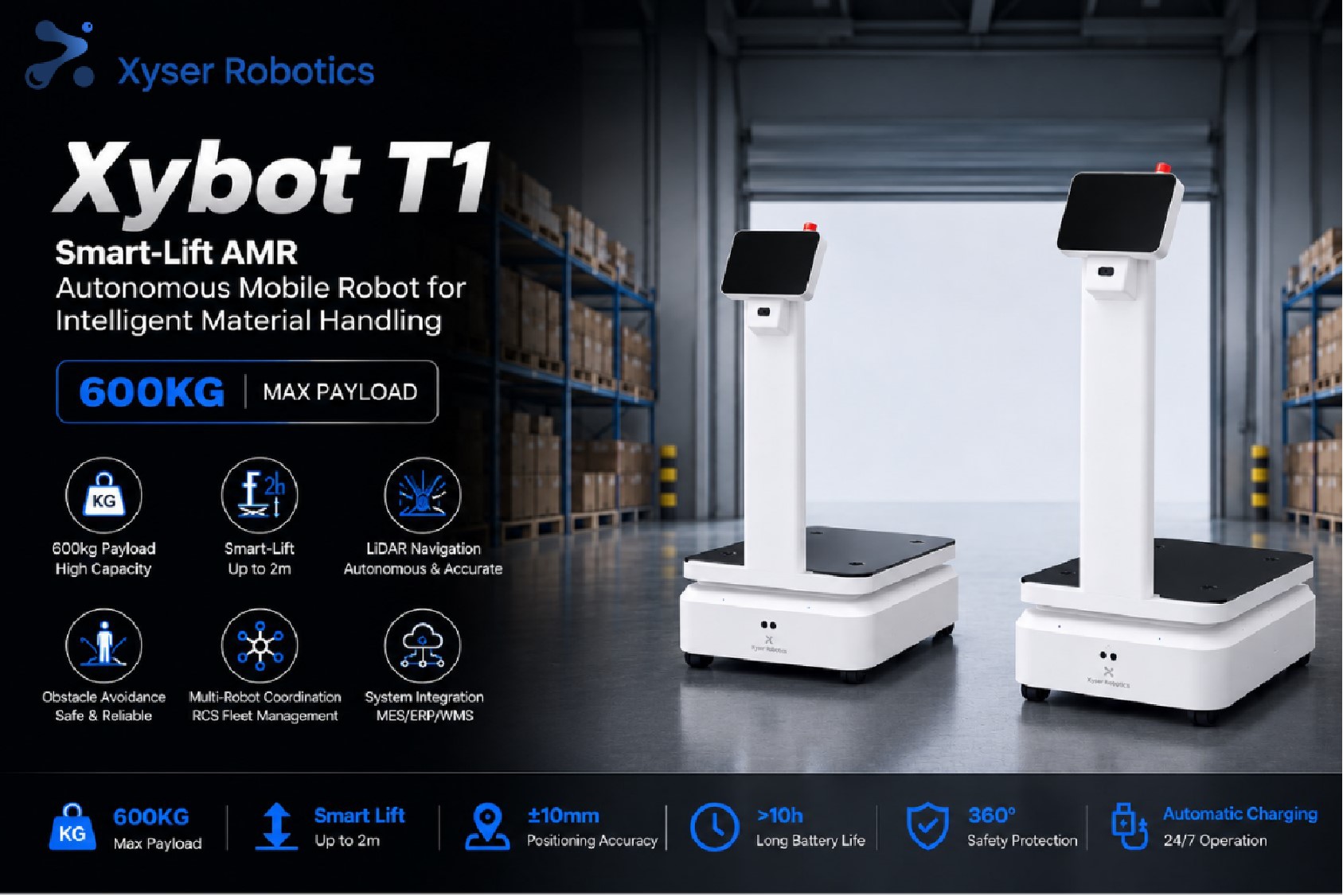
For applications requiring autonomous transportation and lifting, Xybot T1 supports loads of up to 600 kg, providing a solution for material-handling workflows that require more than simple floor-level transportation.
Its smart-lift configuration allows the robot to interact with racks and lift materials, making it suitable for warehouse and factory environments where autonomous transportation and lifting need to work together.
3. Does the AMR Need to Lift or Simply Transport?
This is an important distinction that is sometimes overlooked during the purchasing process.
Not all AMRs perform the same type of material handling.
Some platforms transport goods placed directly on the robot. Others can tow carts, carry containers, move racks, or lift loads to interact with storage systems.
If your operation requires the robot to pick up a rack or position itself underneath a load, lifting capability becomes an important selection criterion.
Xybot T1 is designed as a smart-lift AMR, combining autonomous transportation with lifting capability. It can identify designated shelves and perform automated lifting operations, allowing it to participate in storage and retrieval workflows rather than simply moving from one location to another.
For warehouses considering AMR automation, understanding whether the robot needs to carry, tow, lift, or interact with storage equipment can significantly narrow the appropriate solution.
4. How Reliable Is the Navigation Technology?
Navigation is at the heart of an autonomous mobile robot.
A robot may have impressive hardware specifications, but if it cannot maintain stable positioning or navigate reliably around people and equipment, its practical value will be limited.
When evaluating an AMR, businesses should understand how the robot maps the facility, localizes itself, plans routes, detects obstacles, and responds when the environment changes.
LiDAR-based navigation and multi-sensor perception can provide the robot with environmental information that supports autonomous movement and dynamic obstacle avoidance.
Xybot T1 uses LiDAR navigation to support autonomous positioning, route planning, and obstacle avoidance.
For buyers, however, the most important test is not simply the name of the navigation technology. It is how the robot performs inside your actual facility.
A live site evaluation can reveal challenges that may not be visible in a product specification sheet, including narrow aisles, reflective surfaces, pedestrian traffic, temporary obstacles, loading areas, and changes in warehouse layout.
5. Can the AMR Handle Dynamic Warehouse Environments?
Warehouses are rarely static.
Workers move through aisles. Forklifts transport materials. Pallets may temporarily block routes. Equipment can be relocated, and traffic patterns can change throughout the day.
An AMR therefore needs to operate in an environment where conditions are continuously changing.
Obstacle avoidance should not be treated as an optional feature. It is fundamental to autonomous operation.
When evaluating an AMR, buyers should understand how the robot detects obstacles, how quickly it responds, whether it can re-plan its route, and how it behaves when a path becomes unavailable.
The objective is not simply to make the robot move autonomously.
The objective is to allow it to continue completing transportation tasks reliably while adapting to the environment around it.
6. Can the AMR Integrate With Your Warehouse Systems?
A robot operating independently from the rest of the warehouse can only provide limited automation value.
Modern warehouses increasingly depend on digital systems such as Warehouse Management Systems, Enterprise Resource Planning platforms, and Manufacturing Execution Systems.
When an AMR can receive transportation tasks directly from these systems, material movement can become part of a connected workflow.
This is an important consideration when evaluating an AMR supplier.
Xybot T1 supports integration with MES, ERP, and WMS systems, allowing transportation tasks to be incorporated into wider warehouse and manufacturing processes.
This means the robot can become part of the facility's automation architecture rather than functioning as an isolated mobile machine.
For larger projects, buyers should discuss integration requirements with the supplier before making a purchasing decision, rather than treating software integration as a later-stage issue.
7. What Happens When You Need More Than One Robot?
Many AMR projects start with a single robot.
Once the application proves successful, businesses may want to add more units to increase transportation capacity or expand automation into additional areas.
This makes fleet management an important factor even when the initial deployment involves only one AMR.
Multiple robots operating in the same environment need to coordinate tasks, manage traffic, avoid conflicts, and maintain efficient routes.
Xybot T1 supports an RCS multi-robot control system, allowing multiple robots to be coordinated within a unified transportation workflow.
For businesses planning long-term automation, this scalability can be more valuable than optimizing the performance of a single robot.
The purchasing decision should therefore consider not only:
“How well does one AMR perform?”
but also:
“How will this system perform when we have five, ten, or more robots?”
8. Does the AMR Fit Your Warehouse Layout?
The physical environment is another critical consideration.
Before selecting an AMR, businesses should evaluate aisle width, turning areas, floor conditions, storage configurations, elevators, loading zones, pedestrian routes, and other physical constraints.
A robot that performs well in a large open warehouse may not be appropriate for a facility with narrow aisles and dense storage.
This is particularly important for smart-lift AMRs because the robot needs sufficient space not only to navigate but also to position itself correctly for lifting and transporting loads.
Xybot T1 is designed to operate within warehouse and factory environments while combining autonomous navigation with lifting and material transportation.
The best purchasing process therefore includes a site assessment before finalizing the robot configuration.
9. How Flexible Is the AMR?
Warehouse requirements change over time.
A business may introduce new products, modify its storage system, change production volumes, or add new transportation routes.
An AMR that can only perform one narrowly defined task may become difficult to justify as operations evolve.
Flexibility should therefore be evaluated at both the hardware and software level.
The ability to accommodate different loads, adjust handling configurations, modify transportation routes, and integrate new workflows can extend the useful life of an AMR investment.
Xybot T1 supports adjustable fork spacing and optional conveyor configurations, allowing the platform to adapt to different material-handling requirements.
This flexibility can be particularly valuable for manufacturers and logistics operators whose workflows are expected to evolve.
10. Safety Should Be Evaluated in the Real Operating Environment
Safety is one of the most important considerations when introducing autonomous robots into a facility where people and machines work together.
The robot needs to detect obstacles, respond to unexpected situations, and operate within defined safety requirements.
But safety cannot be evaluated from a brochure alone.
Businesses should consider how the robot behaves around pedestrians, forklifts, racks, doors, temporary obstacles, and other equipment in the actual operating environment.
A proper evaluation should examine both the robot's onboard safety functions and the facility-level safety strategy.
This is another reason why an on-site demonstration or pilot can be valuable before a large-scale deployment.
11. What Should You Consider Beyond the Robot's Purchase Price?
The purchase price of an AMR is only one component of the total investment.
Businesses should also consider software, system integration, installation, training, maintenance, spare parts, battery replacement, connectivity, and future expansion.
The economic value of an AMR should then be compared with the actual manual transportation work being automated.
If employees spend significant amounts of time moving materials between fixed locations, automation may reduce repetitive handling and allow employees to focus on higher-value activities.
For multi-shift operations, autonomous transportation can also help maintain consistent material movement beyond normal working hours.
The most useful ROI analysis is therefore based on your actual transportation volume, labor requirements, operating hours, and workflow constraints.
12. How Should You Evaluate an AMR Supplier?
Choosing the robot is only part of the decision.
The supplier's ability to support the project can have an equally significant impact on its success.
An AMR deployment may require site assessment, route planning, system integration, software configuration, commissioning, operator training, maintenance, and ongoing technical support.
For this reason, buyers should evaluate whether a supplier can provide a complete solution rather than simply deliver a robot.
This is particularly important for customized warehouse automation projects.
A strong supplier should be able to understand your material flow and translate your operational requirements into a practical robotic workflow.
Is Xybot T1 the Right AMR for Your Operation?
Xybot T1 is designed for businesses looking to automate internal material transportation while adding autonomous lifting capabilities to their workflow.
With a payload capacity of up to 600 kg, LiDAR navigation, autonomous route planning, real-time obstacle avoidance, smart shelf recognition, and system integration capabilities, T1 is positioned for warehouse and manufacturing applications that require flexible material movement.
Its support for MES, ERP, and WMS integration allows it to become part of a broader digital logistics system, while multi-robot control provides a foundation for future fleet expansion.
T1 can be particularly relevant when the application involves repetitive material transportation combined with rack or shelf handling.
However, the right AMR ultimately depends on the facility.
The best approach is to evaluate your actual load requirements, transportation routes, operating environment, system architecture, and future automation plans before selecting the final configuration.
AMR vs Autonomous Forklift: Which One Should You Choose?
AMRs and autonomous forklifts serve different material-handling requirements.
An autonomous forklift such as Xybot F1 is designed for heavier pallet transportation and forklift-style material handling, with a maximum payload of up to 2,000 kg.
An AMR such as Xybot T1 is more suitable when the operation requires flexible autonomous transportation combined with smart lifting and integration with warehouse or manufacturing systems.
The decision should therefore be based on the material flow rather than simply comparing robot specifications.
If the primary requirement is heavy pallet movement, an autonomous forklift may be the better fit.
If the operation requires flexible transportation, rack handling, and integration with a broader warehouse workflow, an AMR may be more appropriate.
In larger smart factories, these technologies can also complement each other as part of a wider autonomous material-handling system.
The Final AMR Buying Decision
Choosing an Autonomous Mobile Robot should be approached as an automation project rather than a simple equipment purchase.
The right AMR needs to match your application, payload, lifting requirements, navigation environment, safety requirements, system architecture, and future expansion plans.
More importantly, the robot should fit into the way your facility actually operates.
A successful AMR deployment is not about buying the robot with the longest specification sheet.
It is about selecting a system that can reliably solve a real operational problem and continue creating value as your business grows.
For businesses evaluating AMR automation, Xyser Robotics can help assess material flow, facility requirements, transportation workflows, and system integration needs.
Contact the Xyser Robotics team to discuss a customized AMR solution designed around your warehouse or manufacturing operation.
Explore Xybot T1 for autonomous material transportation and smart-lift applications:
Autonomous Forklift Buyer Guide: How to Choose the Right Solution for Your Warehouse