Introduction
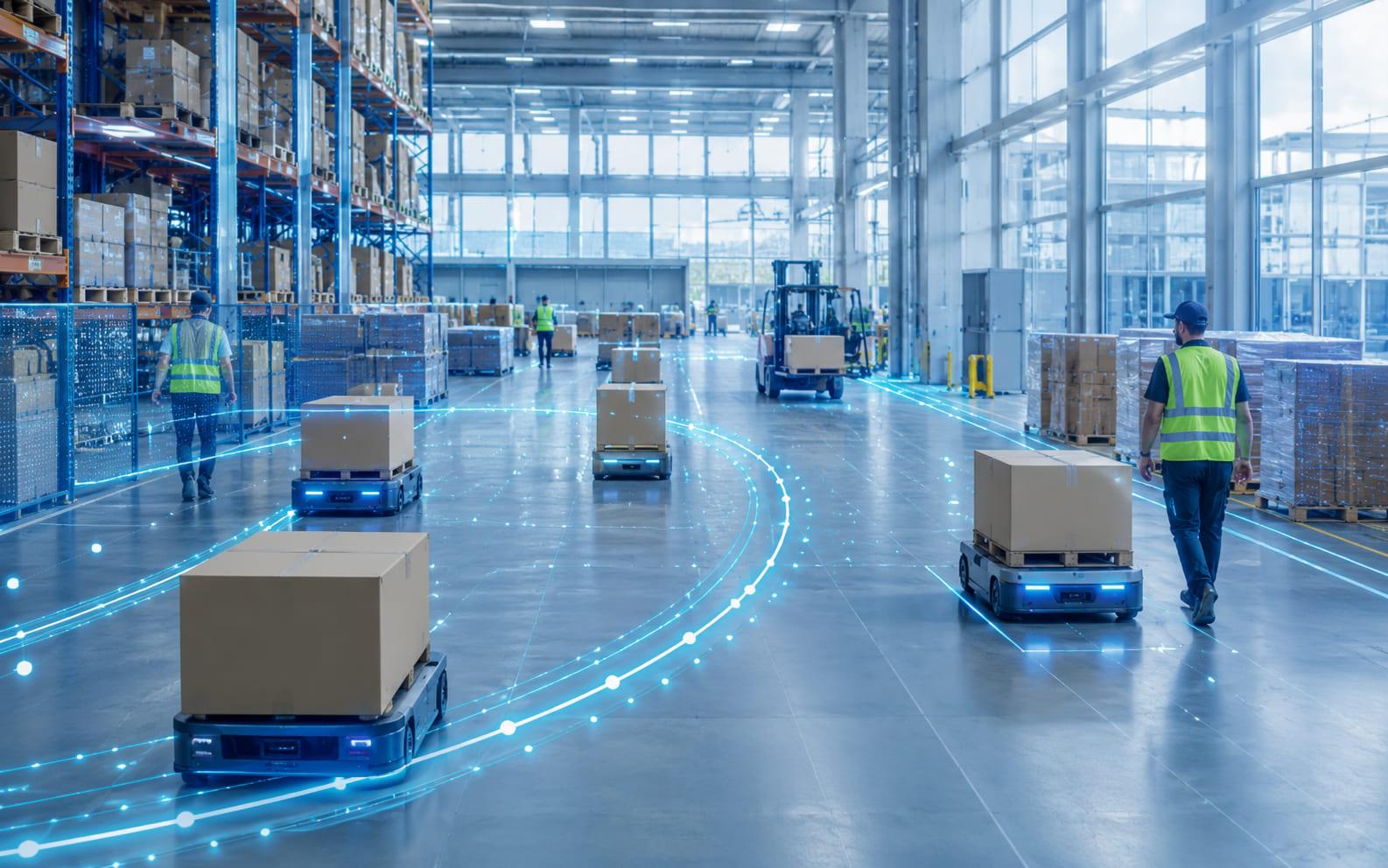
Deploying an Autonomous Mobile Robot (AMR) can help a factory automate repetitive material transportation. However, when a manufacturer moves from one robot to multiple units, the operational challenge changes significantly.
A single AMR can transport materials between two designated locations. A fleet of robots must do much more. It needs to respond to multiple transportation requests, assign tasks according to priority, coordinate shared routes, manage charging schedules, and communicate with existing production and warehouse systems.
Without effective fleet management, adding more robots does not necessarily increase productivity. Several machines may compete for the same narrow aisle, arrive at a loading station simultaneously, or remain idle while waiting for tasks that could have been assigned more efficiently.
This is why AMR fleet management has become an important consideration in modern manufacturing and warehouse automation. The objective is not simply to operate more robots, but to coordinate them as part of one connected material-handling system.
1. What Is AMR Fleet Management?
AMR fleet management refers to the centralized coordination and monitoring of multiple autonomous mobile robots operating within a shared facility.
Rather than allowing each robot to operate independently, a fleet management system coordinates task allocation, movement, operating status, and shared resources.
For example, imagine a manufacturing facility with three production lines and a central warehouse. Each production line periodically requests materials, while finished goods and empty containers need to be transported back to designated locations.
If five AMRs are operating simultaneously, the system must determine which robot should handle each request, which route it should take, and how the remaining robots should respond when multiple tasks compete for the same resources.
An effective fleet management system connects these transportation activities with the factory's existing operating processes.
The Difference Between an Individual AMR and an AMR Fleet
An individual AMR focuses on completing its assigned transportation task. A fleet management system focuses on coordinating the overall transportation operation.
This distinction becomes particularly important as the number of robots increases. Without centralized coordination, independently assigned tasks can create unnecessary waiting, inefficient travel paths, and congestion around shared workstations.
Fleet management allows manufacturers to evaluate the entire operation rather than measuring the performance of each robot separately.
2. How Does AMR Fleet Management Work with MES, ERP, and WMS?
One of the most important parts of industrial AMR deployment is system integration.
In a modern factory, transportation requirements rarely originate from the robot itself. They are generated by production schedules, inventory movements, and warehouse operations.
To automate these processes, businesses need to connect their existing enterprise systems with the robot fleet.
Understanding the Different System Roles
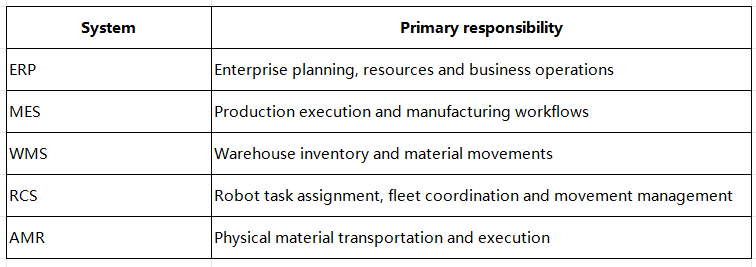
These systems perform different functions, but they must exchange information to support an automated workflow.
For example, when a production line needs additional materials, the MES can generate a material request. The WMS identifies the corresponding inventory and pickup location. The robot control system receives the transportation task, selects an available robot, and coordinates its movement.
Once the material reaches its destination, task completion information can be returned to the connected systems according to the configured integration workflow.
This creates a connection between digital production planning and physical material transportation.
What Happens During an Automated Material Delivery?
A typical workflow can be organized into five stages.
Stage 1: Task Generation
The MES or WMS generates a transportation request containing the pickup location, destination, material identification, and priority.
Stage 2: Task Assignment
The fleet management system evaluates available robots according to payload requirements, location, battery status, and equipment compatibility.
Stage 3: Route Planning
The selected AMR receives its task and plans a suitable route based on the mapped environment and operating restrictions.
Stage 4: Material Transportation
The robot moves the material to its destination, while the fleet management system monitors task progress and manages interactions with other robots.
Stage 5: Task Completion
After the delivery is confirmed, the system updates the relevant task status and makes the robot available for another assignment.
The exact workflow depends on the factory's software interfaces, material-handling equipment, and acceptance requirements. The important point is that the physical delivery and digital task records must remain synchronized.
3. Why Multi-Robot Coordination Matters
As the number of AMRs increases, transportation efficiency depends increasingly on how well robots share the same working environment.
Task Allocation and Priority Management
Not every transportation request has the same urgency.
A production line waiting for raw materials may require immediate attention, while returning an empty container can usually wait until a later time.
A fleet management system should consider task priority, robot availability, payload compatibility, and estimated completion time when assigning work.
Selecting the nearest robot is not always the best decision. The system must also consider whether that robot can safely handle the load, access the required pickup station, and complete the task without creating additional delays elsewhere.
Traffic Management and Collision Avoidance
Factories and warehouses often contain narrow aisles, shared intersections, loading stations, and areas where employees and forklifts operate alongside robots.
When several AMRs use the same routes, poor traffic coordination can lead to unnecessary waiting or operational bottlenecks.
A fleet management system can coordinate movement through shared areas, manage route conflicts, and help prevent multiple robots from entering a restricted passage simultaneously.
Onboard navigation and obstacle detection remain essential because centralized route planning cannot predict every temporary obstacle or unexpected movement.
Charging and Robot Availability
Battery management is another important part of fleet planning.
If several robots reach low battery levels at approximately the same time, the factory may temporarily lose a significant portion of its transportation capacity.
A well-designed operating schedule should consider battery levels, charging opportunities, transportation demand, and expected peak periods.
This helps maintain a more consistent number of available robots throughout the working shift.
Exception Handling and Task Recovery
Real production environments are not always predictable.
A pickup station may become unavailable, an aisle may be temporarily blocked, or a robot may need manual intervention.
The fleet management system should maintain task status and support a clear recovery process. If another robot needs to take over a transportation task, the system must first confirm the physical location of the material and the status of the original task.
This prevents duplicate deliveries, missing inventory records, and unnecessary operational interruptions.
4. What Should Manufacturers Consider Before Deploying an AMR Fleet?
Purchasing multiple robots should not be the first step in an automation project. Manufacturers should begin by understanding the transportation requirements of their facility.
Evaluate Material Flow Before Selecting Robot Quantity
Start by identifying the most frequent transportation routes, including warehouse-to-production movements, line-side replenishment, finished-goods transportation, and empty-container returns.
Measure the number of trips required during a normal shift and identify where delays occur.
This information helps determine the required transportation capacity and whether the factory needs one robot, several robots, or a combination of different robot configurations.
Match Payload and Lifting Requirements
Robot selection should reflect the actual material-handling process.
Manufacturers need to evaluate load weight, dimensions, pallet specifications, lifting height, fork spacing, and the physical condition of the storage racks.
A robot that can transport a load on a flat platform may not be suitable for applications that require autonomous shelf recognition and lifting.
The rated payload should also be checked against the intended load geometry and lifting configuration, rather than relying only on the maximum headline figure.
Assess the Facility Layout
A proper site assessment should examine aisle width, turning space, floor conditions, rack positions, loading stations, pedestrian crossings, and forklift traffic.
These details affect both individual robot navigation and the overall efficiency of a multi-robot fleet.
It is also important to identify locations where robots may need to wait, pass one another, or share access to equipment such as automatic doors and elevators.
Confirm Software Compatibility
Before purchasing, manufacturers should confirm how the robot fleet will communicate with their existing MES, ERP, or WMS platforms.
The evaluation should cover task creation, status feedback, priority handling, error reporting, and inventory update procedures.
Software integration is not simply about establishing a connection. It is about ensuring that transportation tasks can be executed and verified within the factory's existing operational logic.
5. Xybot T1: Smart-Lift AMR for Connected Factory Logistics
For factories looking to automate pallet transportation and integrate mobile robotics into their existing production workflows, Xyser Robotics offers the Xybot T1 smart-lift AMR.
Xybot T1 is designed for factories and warehouses that require autonomous material transportation with intelligent lifting capabilities.
Its payload capacity reaches up to 600 kg, and its scissor lifting mechanism supports lifting operations up to 2 meters. The robot can recognize shelves through QR codes or LiDAR and perform autonomous lifting operations, helping manufacturers automate material movement between storage locations and production areas.
MES, ERP, and WMS Connectivity
One of the key features of Xybot T1 is its integration with enterprise production and warehouse systems.
Tasks generated through connected MES, ERP, or WMS platforms can be transferred into the robot's task queue, allowing transportation requirements to become part of the factory's digital workflow.
This helps manufacturers connect material requests with actual robot execution rather than relying entirely on manual dispatch.
RCS Multi-Robot Coordination
When a factory needs multiple AMRs, centralized coordination becomes increasingly important.
Xybot T1's product information describes an RCS fleet management capability that assigns jobs to dozens of units, balances traffic, and helps prevent deadlocks.
This provides a foundation for manufacturers looking to expand beyond individual robot deployment toward coordinated material transportation.
Flexible Material Handling Configuration
Different factories use different rack designs and material carriers.
Xybot T1 supports adjustable fork spacing and an optional conveyor deck, allowing its configuration to be adapted to different handling requirements.
The appropriate fork configuration, rack compatibility, payload, and lifting performance should be confirmed during project engineering.
For manufacturers planning to scale their logistics automation, the combination of intelligent lifting, enterprise connectivity, and multi-robot coordination makes Xybot T1 a relevant solution to evaluate.
6. How to Measure the ROI of an AMR Fleet
The return on investment of an AMR fleet should not be calculated simply by multiplying the number of robots by the estimated labor savings per unit.
The real value comes from improving the overall material transportation process.
Manufacturers should first establish a baseline of current operations, including the number of transportation trips, average delivery time, employee hours spent on material movement, waiting time, and the frequency of delayed deliveries.
After deployment, these indicators can be compared with actual fleet performance.
Key Performance Indicators to Monitor
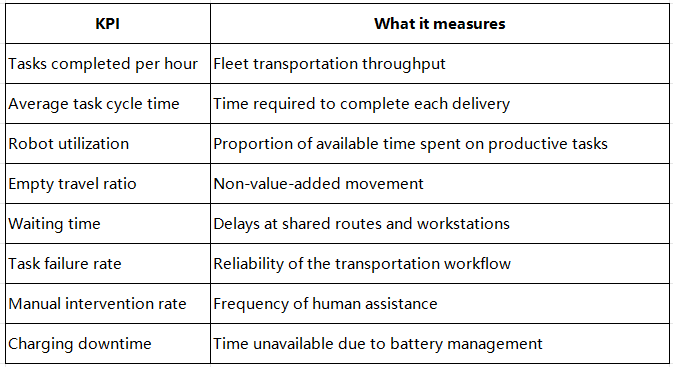
These indicators help identify whether the fleet is actually improving factory operations or simply replacing manual transportation with another operating expense.
Calculating Total Cost of Ownership
The financial evaluation should include more than the initial robot purchase.
Manufacturers should consider robot hardware, charging infrastructure, software integration, deployment engineering, employee training, maintenance, battery replacement, and ongoing technical support.
A useful calculation is:

The estimated payback period can then be calculated as:

This calculation should use realistic operating data. Labor hours released by automation should only be counted as financial savings when they can actually be reduced or productively redeployed. Similarly, production downtime benefits should be measured rather than assumed.
For larger factories, the most important financial advantage may come from more predictable material availability, reduced waiting time, and improved utilization of existing production resources.
7. From One AMR to a Fully Connected Logistics System
The development of industrial mobile robotics is moving beyond the deployment of individual machines.
Manufacturers increasingly need connected transportation systems in which production requirements, warehouse operations, and robot fleets work together.
This does not mean every factory needs a large fleet from the beginning. A more practical strategy is to start with one clearly defined transportation workflow, validate the integration and operating performance, and then expand the fleet as demand increases.
By building the right system architecture from the beginning, manufacturers can avoid unnecessary complexity and create a more scalable foundation for future automation.
Conclusion: Better Coordination Creates Better Automation
AMR fleet management is not simply a software feature. It is an essential part of connecting autonomous robots with the wider factory operation.
The ability to assign tasks intelligently, coordinate traffic, manage battery availability, recover from exceptions, and communicate with enterprise systems determines how effectively a fleet can support daily material movement.
For manufacturers evaluating industrial AMRs, the purchasing decision should therefore consider not only payload, navigation, and lifting capabilities, but also the system's ability to work as part of a coordinated logistics operation.
With its smart-lift design, MES/ERP/WMS connectivity, and RCS multi-robot coordination, Xybot T1 provides a solution worth evaluating for factories seeking to develop more connected and scalable material-handling workflows.
Planning to automate your factory's material transportation?
Contact Xyser Robotics to discuss your payload requirements, facility layout, system integration, and multi-robot deployment plans.