
A Practical ROI Guide for Premium Coffee Chains in Saudi Arabia
In Saudi Arabia’s fast-growing specialty coffee market, automation is no longer a “nice-to-have” — it has become a core operational strategy. But before investing in a fully automatic coffee machine, every operator should run one crucial calculation:
Will this machine improve my shop’s economics — and by how much?
This article provides a clear, numbers-based framework to help owners and HQ operators understand how automation influences revenue per sqm, peak-hour output, labor allocation, and multi-store expansion decisions.
1. Revenue per Sqm Model
Goal: Improve shop revenue productivity & evaluate expansion feasibility.
1) Industry Benchmarks (Specialty Chains in KSA)
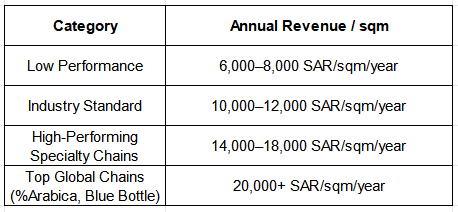
2) Revenue Density Formula
Revenue per sqm = Annual Revenue ÷ Service Area
Service Area (SA) includes:
-
Customer seating
-
Bar counter
-
Coffee equipment zone
❌ Excludes storage, back-of-house, changing rooms.
3) How Automatic Coffee Machines Increase Revenue per Sqm
Automation impacts three critical variables:
① Peak Output Capacity (+20–40%)
Most cafés hit a production bottleneck between 9–11 am.
Automation removes this bottleneck, enabling more cups served within the same footprint.
② Shorter Waiting Time (reduces peak-hour walkaways by 10–15%)
Your main customer base — students and office workers — is extremely sensitive to queue time.
If the line is too long, they simply leave.
③ More Stable Service → Higher Table Turnover (+8–12%)
Automation =
-
Consistent drink quality
-
Less chaos at the bar
-
Staff free to focus on customers
Typical impact for a northern-region premium café:
Revenue per sqm increases 12–22%
2. Peak-Hour Output Model
1) Typical Output Capacity (Specialty Chains)
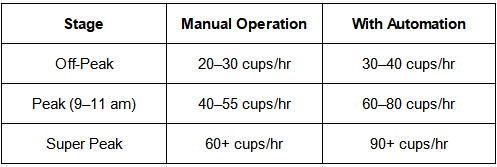
2) Peak Loss Model
Peak-hour overload → lost orders → lower revenue per sqm & weak ROI.
Formula
Peak Loss = (Peak Traffic – Actual Capacity) × Margin per Cup
Real Example (Premium Chain in KSA):
-
Peak demand: 70 cups/hr
-
Manual capacity: 50 cups/hr
-
After automation: 75 cups/hr
Lost orders recovered:
(70 – 50) × 16 SAR = 320 SAR/hr saved
Over time:
-
× 2 hours/day
-
× 26 days/month
16,640 SAR additional revenue per month
This single metric often pays back the machine in months, not years.
3. Staffing Optimization Model
Typical Specialty Store Salaries
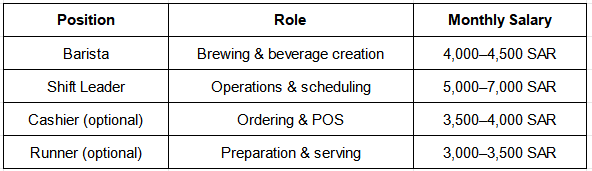
1) Whom Can Automation Replace?
Automatic coffee machines are not for cutting full-time staff.
They replace peak-hour temporary labor or remove the need for an additional barista.
Typical savings:
→ 2,500–3,500 SAR/month
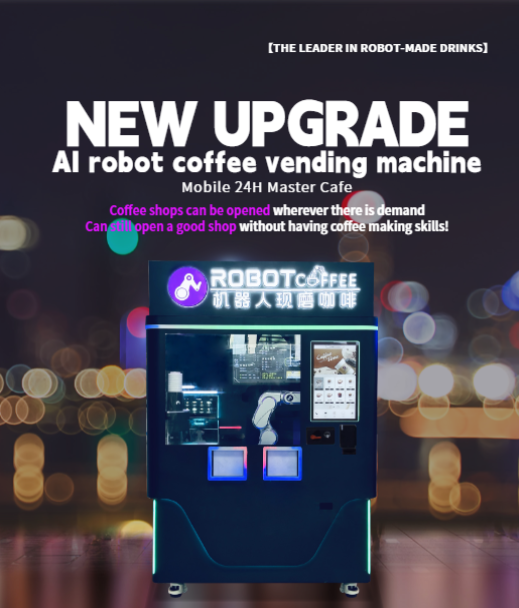
2) Ideal Staffing After Automation
Traditional Model (3–4 staff)
✔ Barista
✔ Shift Leader
✔ Cashier
✔ Runner
Optimized Model (2–3 staff)
✔ 1 skilled Barista
✔ 1 Shift Leader
✔ Optional reduction of Runner/Cashier during off-peak
Result:
-
8–12% labor cost reduction
-
~10% table turnover improvement
4. Scalable Growth Model for Chain Brands
Use automation + shop performance data to judge which locations are expansion-ready.
HQ’s Three Key Metrics
1) Revenue Density ≥ 14,000 SAR/sqm/year
Indicates strong demand & proven concept.
2) Peak Capacity Utilization ≥ 75%
If peak demand consistently exceeds bar output →
automation becomes mandatory to prevent ongoing losses.
3) Revenue per Staff ≥ 23,000 SAR/month/person
With automation, leading chains achieve:
26,000–30,000 SAR per staff
Stores that meet all 3 conditions = Ideal candidates for fully automatic coffee equipment and rapid expansion.
Automation doesn't just improve shop operations —
it provides HQ with a scalable, repeatable, high-margin store model.
Final Thoughts: Automation Is Not a Cost — It’s a Compounding Asset
For specialty coffee chains in Saudi Arabia, the question is no longer:
❌ “Should we automate?”
but rather:
✅ “Where can automation bring the highest ROI the fastest?”
By improving:
-
Revenue per sqm
-
Peak-hour output
-
Labor efficiency
-
Replicable chain-wide performance
Automatic coffee machines help cafés grow healthier, faster, and more profitably.
Read more: Industry Adoption of Service Robots: A Cross-Sector Analysis for 2025


