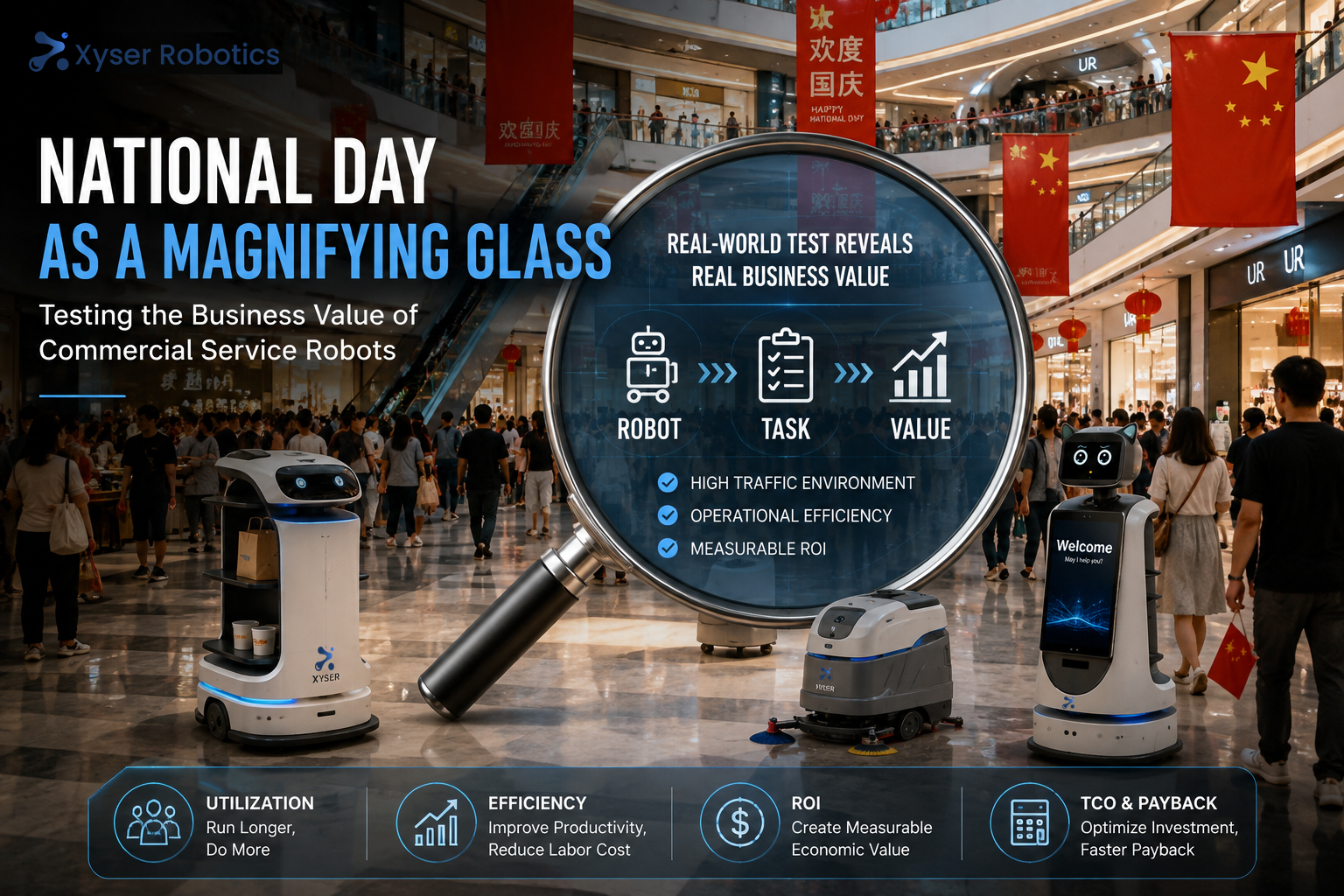
China's National Day holiday runs from October 1 to October 7 and is one of the country's major annual travel and consumption periods. For the robotics industry, however, the importance of this period goes beyond holiday traffic. Shopping malls become busier. Tourist attractions receive more visitors. Restaurants face heavier service demand. Hotels deal with higher guest volumes. Public spaces become more crowded and operationally more complex.
In other words, National Day acts like a magnifying glass. It makes both the strengths and weaknesses of commercial service robots easier to see. A robot that looks impressive in a controlled demonstration may behave very differently in a crowded mall. A delivery robot that works occasionally may look very different when its utilization increases sharply. And a robot that attracts thousands of visitors may generate very different economic value from one that quietly performs repetitive operational work every day.
This leads to a more important question for the commercial robotics industry: Are robots becoming more useful, or are they simply becoming more visible? Recent industry data suggests that commercial service robotics is moving deeper into real-world operations. The International Federation of Robotics reported that global shipments of professional service robots increased 24% in 2025 to almost 250,000 units, with transportation and logistics remaining the largest application category at 117,500 units. The next stage of the industry is therefore less about demonstrating what robots can do and more about proving what business value they can create.
1. National Day Is a Real-World Test for Commercial Service Robots
A laboratory, showroom or exhibition floor can demonstrate a robot's technical capabilities. A busy commercial environment tests something much more difficult: whether those capabilities remain useful when conditions become unpredictable. During a major holiday, robots may encounter dense pedestrian traffic, temporary obstacles, changing routes, longer operating hours and higher service demand.
This is particularly relevant for mobile service robots. A delivery robot may need to complete substantially more transport tasks. A cleaning robot may need to cover larger areas during extended operating hours. A reception robot may interact with significantly more visitors. A guide robot may need to answer repeated questions from different users throughout the day. The important observation is that higher traffic does not simply create more opportunities for robots. It also exposes operational limitations. Navigation reliability, obstacle avoidance, battery management, task scheduling, human-robot interaction and recovery from unexpected situations all become more important when utilization increases. This is why large-scale public events and holiday periods can function as valuable real-world environments for evaluating commercial robotics.
China is already creating more of these environments. Beijing, for example, launched a Robot Consumption Street in 2026, bringing robots into commercial and consumer-facing environments rather than limiting them to traditional industrial demonstrations. The significance is not simply that people can see more robots.It is that robots are increasingly being placed where real users, real workflows and real business expectations exist.
2. Attention Does Not Automatically Equal Business Value
One of the most visible trends in robotics today is the rise of robots designed to attract attention. Humanoid robots can dance. Interactive robots can talk with visitors. Service robots can take photographs, demonstrate movements or create memorable experiences. These applications have genuine value.A robot that increases foot traffic, creates social media content or improves customer engagement can contribute to a company's marketing strategy.
But attention alone is not the same as business value. The important question is: What happens after the customer stops watching? A robot that attracts attention but has no measurable effect on customer engagement, sales, service capacity or operational efficiency may remain primarily a demonstration. Meanwhile, a delivery robot moving quietly through a hotel corridor may attract almost no attention from guests while creating measurable operational value every day. This distinction is becoming increasingly important as commercial robotics matures.
The industry is moving from “Look what the robot can do” toward “What problem does the robot solve?” That does not mean interactive or entertainment-oriented robots have no commercial future. It means their business case should be measured differently. A marketing robot may be evaluated through visitor traffic, engagement and conversion. A delivery robot may be evaluated through completed deliveries, labor hours released and throughput. A cleaning robot may be evaluated through coverage, labor utilization and operating hours. The robot does not have to perform the same job as a human employee to create value. But the value needs to be identifiable.
3. The Industry Is Moving From “Robot Show” to “Robot Job”
The next major shift in commercial robotics is therefore not simply better hardware.It is the transition from demonstrating capabilities to assigning robots clearly defined jobs.This distinction matters because businesses do not normally purchase technology simply because it is impressive.They purchase technology because it solves an operational problem.
Delivery robots are a clear example. Their value comes from performing repetitive transportation tasks that occur again and again: moving meals, goods, documents or other items between predefined locations. Cleaning robots follow a similar logic. Their value is associated with repeatedly covering designated areas and reducing the amount of manual time required for routine cleaning. Reception robots have a different business model. Their value may come from greeting visitors, answering questions, providing directions, delivering information or supporting multilingual communication.
The important characteristic is not that these robots look intelligent. It is that they are assigned a repeatable workflow.This is also consistent with the direction of the broader professional service robotics market. According to the IFR's latest figures, transportation and logistics represented 47% of professional service robot shipments in 2025, making it the largest application category. That is a useful signal. The commercial robotics market is not being built only around robots that look human. It is also being built around robots that perform specific, measurable and repeatable jobs.
4. Real Commercial Environments Are Becoming the New Robotics Testbeds
The most interesting robotics deployments are increasingly happening outside traditional technology demonstrations. Hotels, restaurants, shopping malls, hospitals, airports, logistics facilities, museums and tourist attractions all present different operating conditions. They also have something in common: They contain real workflows that need to be completed repeatedly.
This makes them valuable testbeds for commercial service robots.
- A hotel can evaluate whether a delivery robot can handle room-service workflows.
- A shopping mall can evaluate whether a reception or guide robot can interact with visitors while navigating around crowds.
- A restaurant can evaluate whether delivery automation can improve table-service efficiency.
- A hospital can evaluate whether internal delivery robots can handle repetitive logistics tasks under its own operational and hygiene requirements.
- A tourist attraction can evaluate whether an interactive robot creates measurable visitor engagement rather than simply generating a temporary spectacle.
This shift is already visible in China's robotics ecosystem. Beijing's 2026 Robot Consumption Street brought dozens of robot companies and different consumer-facing applications into a dedicated commercial environment, while broader robot-industry events have increasingly emphasized applications in logistics, retail, food service, healthcare and other real-world sectors.
The implication for international buyers is important. The question is becoming less: “Where can I see a robot?” and more: “Where can this robot fit into my existing workflow?”
5. The Business Question Is Becoming “What Is the ROI?”
This may be the most important change in commercial robotics. Technical specifications still matter. Payload matters. Battery life matters. Navigation matters. Safety matters. AI capabilities matter. But once a company moves from testing to purchasing, another layer becomes decisive: Return on investment. A commercial service robot can potentially create economic value in several ways.
- Labor savings. A robot handles repetitive transportation, cleaning or routine service tasks, employees can spend more time on higher-value activities.
- Productivity improvement. A robot does not necessarily have to replace a full employee. It may allow the existing team to complete more work during the same operating period.
- Additional revenue. A reception or interactive robot may increase customer engagement, promote services or support conversion.
- Service consistency. A robot can perform standardized tasks according to programmed workflows, potentially reducing variation in repetitive operations.
- Operational scalability. Once a workflow is standardized, adding additional robots may be easier than expanding the same operation entirely through additional labor.
This is why the commercial robotics industry is increasingly discussing measurable economic outcomes rather than technology demonstrations.
Industry analysis in China is also pointing in this direction. A recent Third Bridge analysis described China's commercial service robotics sector as moving toward a new phase focused on efficiency, integrated capabilities and profitability, while noting that repetitive, standardized hotel delivery applications are particularly attractive because their ROI can be quantified directly.
The question is no longer simply: Can a robot perform the task?
It is: How much economic value does the robot create by performing the task?
6. The Future May Be a Specialized Robotics Ecosystem
Another important trend is becoming clearer as commercial robotics develops.
The future may not belong to a single robot that tries to do everything.
Instead, commercial environments may increasingly use multiple specialized robots, each optimized for a particular job.
One robot may handle delivery.
- Another may handle floor cleaning.
- Another may provide reception and visitor interaction.
- Another may perform security patrols.
- Another may support warehouse transportation.
The advantage of specialization is straightforward. A robot designed around a clearly defined workflow can be optimized for its payload, navigation requirements, operating environment, interaction model and software integration. This also makes its business case easier to calculate.
Instead of asking whether one general-purpose robot can replace multiple categories of workers, a business can ask a much more practical question:
Which specific task generates enough repetitive cost or operational demand to justify automation?
This may also explain why professional service robotics is scaling in areas such as transportation and logistics, where workflows are already relatively structured and measurable. The latest IFR data shows transportation and logistics leading professional service robot applications, while overall professional service robot shipments rose 24% in 2025.
The longer-term commercial robotics ecosystem may therefore look less like “one robot that does everything” and more like “the right robot for the right job.”
That is a potentially more practical path toward large-scale automation.
7. The Real Test Is Robot Economics: TCO, ROI and Payback
This is ultimately where the commercial robotics discussion becomes a business discussion.
A robot can operate reliably every day and still be a poor investment.
Likewise, a robot can attract enormous attention during a major holiday and still fail to generate sufficient economic value.
For a business owner, the real test is whether the value created by automation is greater than the Total Cost of Ownership (TCO).
The calculation should go beyond the robot's purchase price.
TCO may include hardware, installation, software, system integration, training, maintenance, spare parts, energy consumption and downtime. Depending on the deployment, the business may also need to consider human supervision and facility modifications. Industry guidance on service-robot economics similarly emphasizes that hardware price represents only part of the complete investment.
A simplified commercial model can therefore be expressed as:
Net Annual Robot Value = Labor Savings + Productivity Gains + Additional Revenue + Other Quantifiable Benefits − Annual Operating Cost
And:
Payback Period = Initial Investment ÷ Annual Economic Benefit
Consider a simplified example.
If a robot and its deployment require a total initial investment of $20,000, and the business estimates that the robot generates $1,800 in net monthly economic value, the simple payback period would be approximately:
$20,000 ÷ $1,800 = 11.1 months
The actual calculation will depend heavily on the application, local labor costs, utilization, maintenance, integration and financing model. The purpose is not to promise a universal payback period. It is to establish the correct way to evaluate the investment.
This is particularly important because utilization changes the economics.
A robot used for one hour a day and a robot used for ten hours a day are technically the same machine, but economically they are completely different assets.
This is why National Day can be useful as a magnifying glass.
- Higher traffic can reveal whether a robot can handle greater utilization.
- Higher service demand can reveal whether the robot actually increases capacity.
- Longer operating periods can reveal battery and uptime limitations.
- More interactions can reveal whether AI and navigation systems work effectively in unpredictable environments.
- And, most importantly, higher utilization provides more data for evaluating the economic model.
The commercial robotics question therefore reaches its most important form: Not “Can the robot work?” Not even “Will people like the robot?” But “Can the robot create measurable economic value at a cost that makes business sense?”
That is the real test of commercial service robotics.
What This Means for Businesses Considering Service Robotics
At Xyser Robotics, we believe commercial robotics should begin with the workflow and business objective, not simply the robot itself.
Whether the goal is delivery automation, commercial cleaning, reception and visitor interaction, security patrol or another service workflow, the right solution depends on the operating environment, task frequency, utilization, integration requirements and expected return.
If your company is evaluating how service robots could fit into your hotel, restaurant, retail space, hospital, commercial facility or public venue, contact Xyser Robotics to discuss a customized robotics automation solution.