
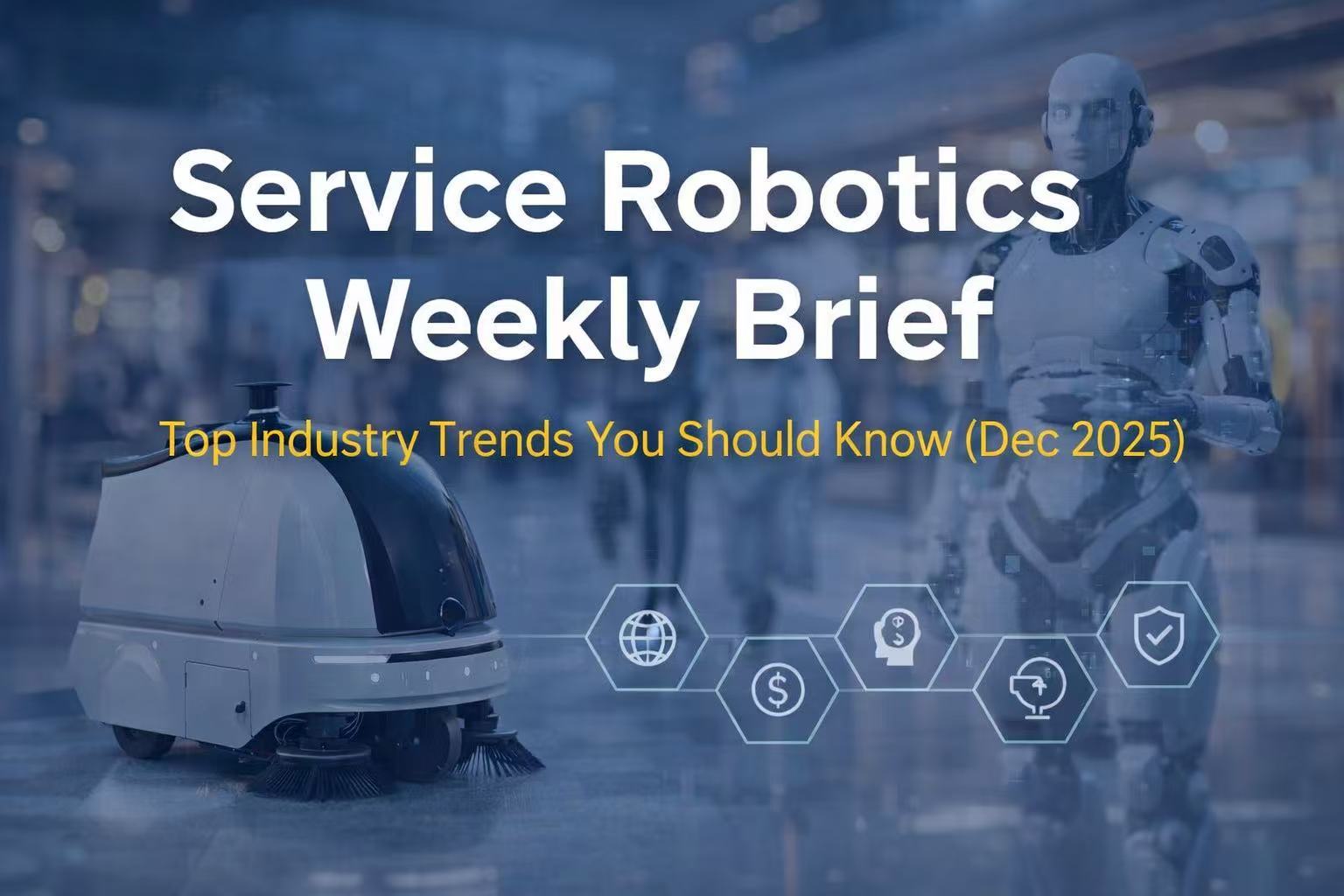
This Week in Service Robots — Key Trends You Shouldn’t Miss
Dec 22–27, 2025
As service robots move from pilot projects to scaled deployment, the industry is shifting fast — not just in technology, but in business models, regulation, and real-world adoption.
Here are five service robotics trends worth paying attention to this week, especially if you’re planning automation strategies for 2026.
1. The Service Robotics Market Is Accelerating Faster Than Expected
This week, new market research projects the global service robotics market to exceed USD 168 billion by 2033, growing at nearly 15% CAGR.
What’s driving the growth is no longer experimental use cases, but:
-
Labor shortages becoming structural, not cyclical
-
Rising expectations for consistency and uptime
-
Strong demand from logistics, healthcare, commercial cleaning, and hospitality
Why it matters:
Service robots are no longer “optional innovation.” For many facilities, they are becoming baseline operational infrastructure.
2. Robotics-as-a-Service (RaaS) Gains Investor and Enterprise Attention
Robotics companies offering subscription-based deployment models are receiving growing attention from both investors and enterprise buyers.
Instead of large upfront purchases, more customers now prefer:
-
Monthly or usage-based pricing
-
Predictable operating costs
-
Vendor-managed maintenance and updates
Why it matters:
This signals a clear shift from selling robots to selling outcomes. The competitive edge is moving toward fleet management, uptime, and software intelligence — not just hardware specs.
3. Humanoid Robots Dominate Headlines — But Not Deployments
With CES 2025 approaching, humanoid robots are once again in the spotlight, fueled by announcements from major players like Boston Dynamics.
However, real-world deployments tell a different story:
-
Most enterprises still prioritize task-specific robots
-
ROI-driven buyers focus on cleaning, delivery, and material handling
-
Humanoids remain high-cost, low-scale in commercial environments
Why it matters:
Humanoids shape long-term vision, but purpose-built service robots continue to drive near-term automation gains.
4. Service Robots Expand into Customer-Facing Hospitality Spaces
This week, reports from Australia highlighted cafés adopting robot servers to cope with rising labor costs.
While reactions are mixed, the trend is clear:
-
Robots are moving from back-of-house to front-of-house
-
Cost pressure is pushing experimentation, even in service-heavy sectors
-
Customer acceptance is improving — but still context-dependent
Why it matters:
Hospitality remains one of the most challenging environments for automation. Each real deployment provides valuable insight into where robots truly add value — and where humans remain irreplaceable.
5. Security, Compliance, and Trust Are Becoming Core Topics
A recent European law enforcement report raised concerns about future misuse of AI-powered robots, including data security and system vulnerabilities.
While largely forward-looking, it reflects a broader shift:
-
Governments are paying closer attention
-
Enterprises are asking tougher questions about data, cloud access, and compliance
-
Trust is becoming a competitive differentiator
Why it matters:
As robots become more autonomous and connected, security and governance will shape adoption just as much as performance and cost.
What This Means Going Into 2026
Across these trends, one theme is consistent:
The service robotics industry is moving from “can robots work?”
to “can robots scale, integrate, and be trusted?”
In 2026, winners will not be defined by hardware alone, but by:
-
Operational reliability
-
Fleet intelligence
-
Business model flexibility
-
Compliance-ready global deployment
Sources & References
(For readers who want to explore further)
-
Mordor Intelligence — Service Robotics Market Forecast 2025–2033
-
IFR (International Federation of Robotics) — World Robotics Service Robots Report
-
Reuters / AP News — Reports on service robots in hospitality and retail (Dec 2025)
-
European Union Agency for Cybersecurity (ENISA) — AI & Autonomous Systems Risk Outlook
This weekly brief synthesizes publicly available industry reports, media coverage, and market observations to highlight key trends relevant to service robot deployment and decision-makers.
Subscribe to our weekly brief to stay ahead of how service robots are reshaping real-world operations — not just in theory, but on the floor.


