
From Interaction Devices to AI-Backed Instructional Infrastructure
Technology Background: Why Human-Centered Education Needs Model-Driven Support
In primary and early education, the core constraint is no longer curriculum quality or digital access.
It is how limited human attention is distributed across growing class sizes and diverse student needs.
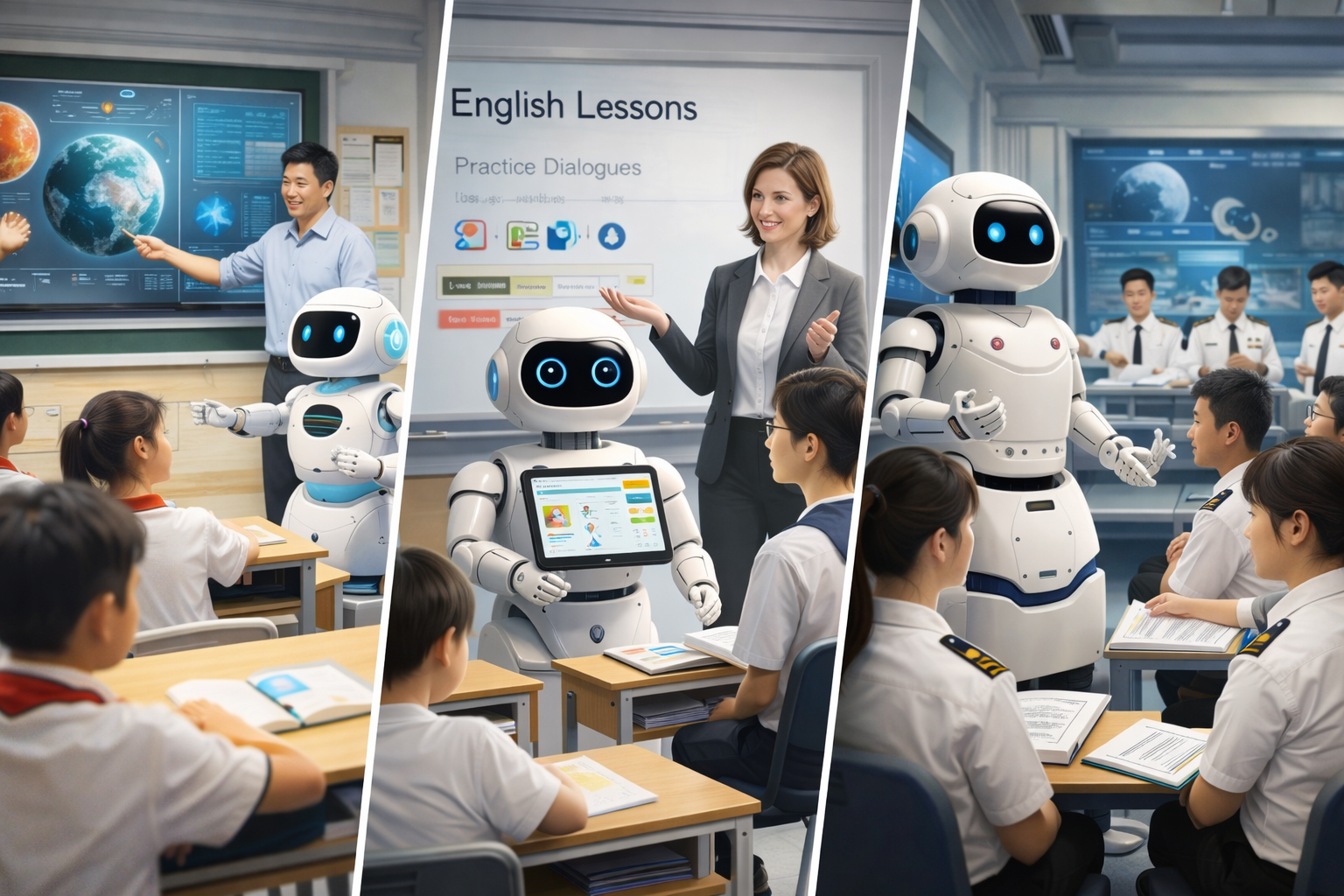
accompany robots are increasingly deployed not as teaching tools, but as human-facing systems connected to educational AI models, designed to extend instructional presence while preserving teacher authority.
What differentiates successful deployments from failed pilots is not hardware sophistication—but how robots are architected around education-specific AI models.
Core Technology Principle: Robots as Interfaces, Models as Pedagogy
In mature education deployments, accompany robots do not “teach.”
They function as interactive shells connected to constrained, education-aligned AI models that reproduce how teachers teach, not what teachers teach.
This separation defines the modern education robot stack:
1. Robot body → interaction, presence, behavioral control
2. Education AI model → instructional logic, explanation structure, boundaries
3. Teacher → content ownership and pedagogical authority
The following three deployment models represent where this technology is actually working in classrooms today.
Case 1: Accompany Robots Connected to Teacher-Defined Educational Models (K–12)
Deployment pattern observed in Japan & Europe
In several K–12 pilots using accompany-style humanoid robots (e.g., SoftBank Robotics - Pepper), robots are connected to education-specific language models trained on teacher-provided materials, rather than open-domain LLMs.
How the system works
Teachers provide:
1. Lesson explanations
2. Step-by-step problem-solving logic
3. Common misconceptions
The AI model:
1. Structures this input into reusable instructional pathways
2. Restricts responses to teacher-approved logic
The accompany robot:
1. Repeats explanations
2. Walks students through reasoning steps
3. Answers clarification questions using the teacher’s original framework
Why this model succeeds
No hallucination risk
Full pedagogical consistency
Teachers remain the single source of truth
The robot becomes a teaching presence multiplier, especially during after-class practice and self-study periods.
Case 2: Accompany Robots Integrated with School-Owned or Private Educational LLMs
Emerging adoption model in international schools and private education groups
Rather than connecting robots to public AI services, some institutions deploy accompany robots as physical access points to school-owned educational AI models.
Technical characteristics
Models are trained on:
1. Curriculum frameworks
2. Internal teaching materials
3. Institution-approved knowledge trees
Robots handle:
1. Student interaction
2. Turn-taking and attention control
3. Escalation to teachers when needed
Classroom impact
Students receive:
1. Consistent explanations aligned with classroom instruction
2. Personalized pacing without fragmenting teaching logic
Institutions gain:
1. Data control and compliance
2. Clear boundaries between AI assistance and human instruction
This model aligns strongly with FERPA / GDPR-oriented education governance, making it increasingly attractive in Western markets.
Case 3: Accompany Robots + Emotion & Behavior Models in Early Childhood Education
The only scalable AI model approach for kindergartens
In early-age classrooms, successful deployments avoid knowledge-centric models altogether.
Instead, accompany robots are paired with emotion recognition and behavior-response models.
Functional role
Robots do not explain content. They: detect emotional states (distraction, frustration, excitement), execute predefined interaction scripts, redirect attention and stabilize classroom flow.
Why this works
1. Emotional regulation is the bottleneck in early education
2. Predictable behavior is more important than intelligence
3. Teachers remain fully in control of learning activities
Here, AI enhances classroom order and engagement, not instruction itself.
Why These Models Succeed Where Others Fail
Across all three cases, one principle holds:
Education robots succeed when AI autonomy is constrained and pedagogically aligned.
Systems that attempt open-ended teaching or content generation consistently face resistance from educators and regulators.
Successful accompany robots behave as educational infrastructure, not experimental AI agents.
Deployment Guidance for Decision-Makers
Before adopting accompany robots integrated with AI models, institutions should evaluate:
Who owns and controls instructional data
How AI outputs are constrained
Whether robots reinforce or disrupt teaching authority
How seamlessly systems integrate into daily classroom workflows
The question is not whether AI is advanced enough—but whether it is governed correctly.
Conclusion: Education Robots Are Model-Driven, Not Feature-Driven
The future of accompany robots in education is not defined by smarter hardware or louder marketing.
It is defined by how well robots serve as controlled interfaces to educational AI models, extending teachers’ reach without fragmenting pedagogy.
For institutions facing teacher shortages, attention overload, and scalability pressure, this model-driven approach represents the most viable path forward.
Contact our experts to see how AI-powered classroom assistance supports teachers and students at scale.
Further Reading / References
-
Humanoid robot delivers trial lecture at primary school science class. Global Times (China).
https://www.globaltimes.cn/page/202510/1346763.shtml -
Shanghai University integrates humanoid robot in aviation English pilot program. SUES News (Shanghai University of Engineering Science).
https://en.sues.edu.cn/72/d3/c26986a291539/page.htm - Pepper Adapted with “Academy Mode” for Classroom Teaching Assistance. PR Newswire.https://www.prnasia.com/story/286490-1.shtml


