
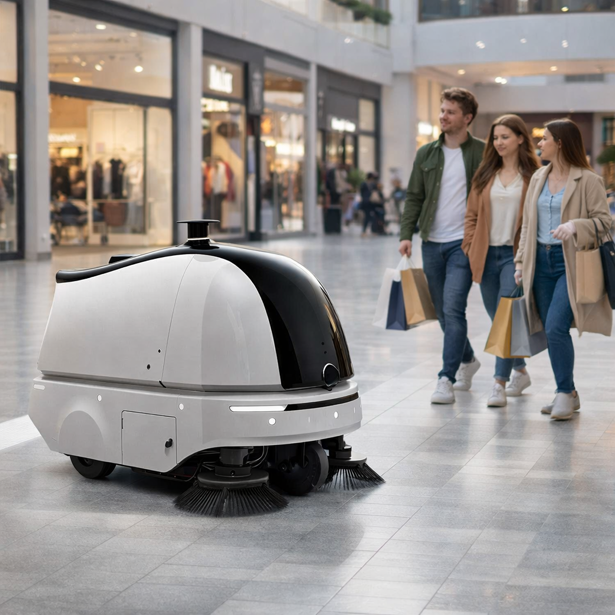
Automation is spreading across malls, airports, and commercial buildings faster than ever.
Yet behind the scenes, many facilities still struggle to operate robots efficiently.
Robots are being deployed faster than organizations can absorb them.
What Is the Difference Between AI Cleaning and Non-AI Cleaning?
Not all cleaning robots are intelligent.
Non-AI cleaning robots operate on pre-defined routes and fixed cleaning modes.
They execute instructions but do not understand their environments.
When layouts change, traffic increases, or conditions vary, human intervention becomes necessary—re-mapping routes, resetting tasks, or correcting failures.
These robots automate motion, not operations.
AI cleaning robots, by contrast, operate differently.
They perceive environments, decide cleaning modes, and adapt cleaning routes dynamically.
Instead of following static instructions, they interpret real-world conditions and adjust behavior accordingly.
The difference is not intelligence for its own sake—it is operability at scale.

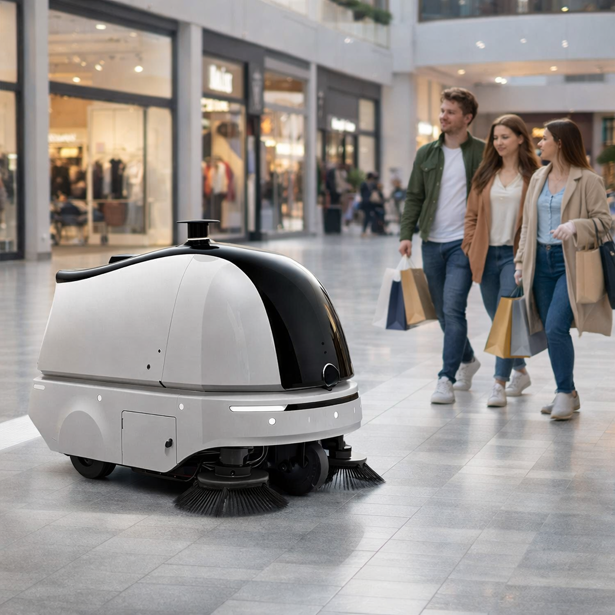
Why Most Companies Still Struggle With Robot Operations
Despite vendor claims of “full autonomy,” reality looks different.
Over 60% of facilities still rely on staff to intervene—re-mapping routes, restarting robots, or resolving navigation issues.
As robot fleets grow, operational complexity increases rather than decreases.
Without AI-driven autonomy, robots reduce labor on the floor but increase labor in operations.
Why AI Cleaning Matters to Labor Economics
A common misconception is that cleaning robots eliminate cleaning jobs.
In practice, labor does not disappear—it shifts upward.
Low-skill night-shift roles decline.
Mid-skill robot operators and system managers increase.
Many organizations see higher labor costs during the first 12–18 months of deployment.
Robots do not replace cleaners.
They reshape the workforce hierarchy.
Without AI, this shift creates management overhead rather than efficiency.
Two Uncomfortable Predictions for 2025–2030
Prediction 1:
By 2030, 50% of shopping malls will eliminate manual night-shift cleaning.
This is driven by:
-
24-hour operations
-
Rising expectations for consistent floor quality
-
The inability of human teams to scale after hours
Night cleaning is becoming structurally unsustainable.
Prediction 2:
Within three years, Chinese brands will control over 70% of the global cleaning robot market.
China already leads in:
-
Robotics supply chains
-
Hardware cost structures
-
Software iteration speed
-
Integrated fleet ecosystems
These shifts will redefine global pricing and competition.
The Most Overlooked Shift: Supervisors Are More Replaceable Than Cleaners
The most sensitive change is not happening on the floor.
With cloud fleet management, AI reporting, and remote monitoring,
supervisor-level roles—not cleaners—are becoming the most automatable layer.
Manual cleaners remain essential.
Continuous human supervision does not.
Why AI Cleaning Robots Actually Matter
The real automation is not happening on the floor — it is happening in decision-making.
AI cleaning robots matter not because they clean better,
but because they remove the need for constant human judgment at scale.
Automation is coming—but not in the way most people expect.
Read More
2.Before Buying a Robotic AI Coffee Machine, Do the Math First


