Introduction
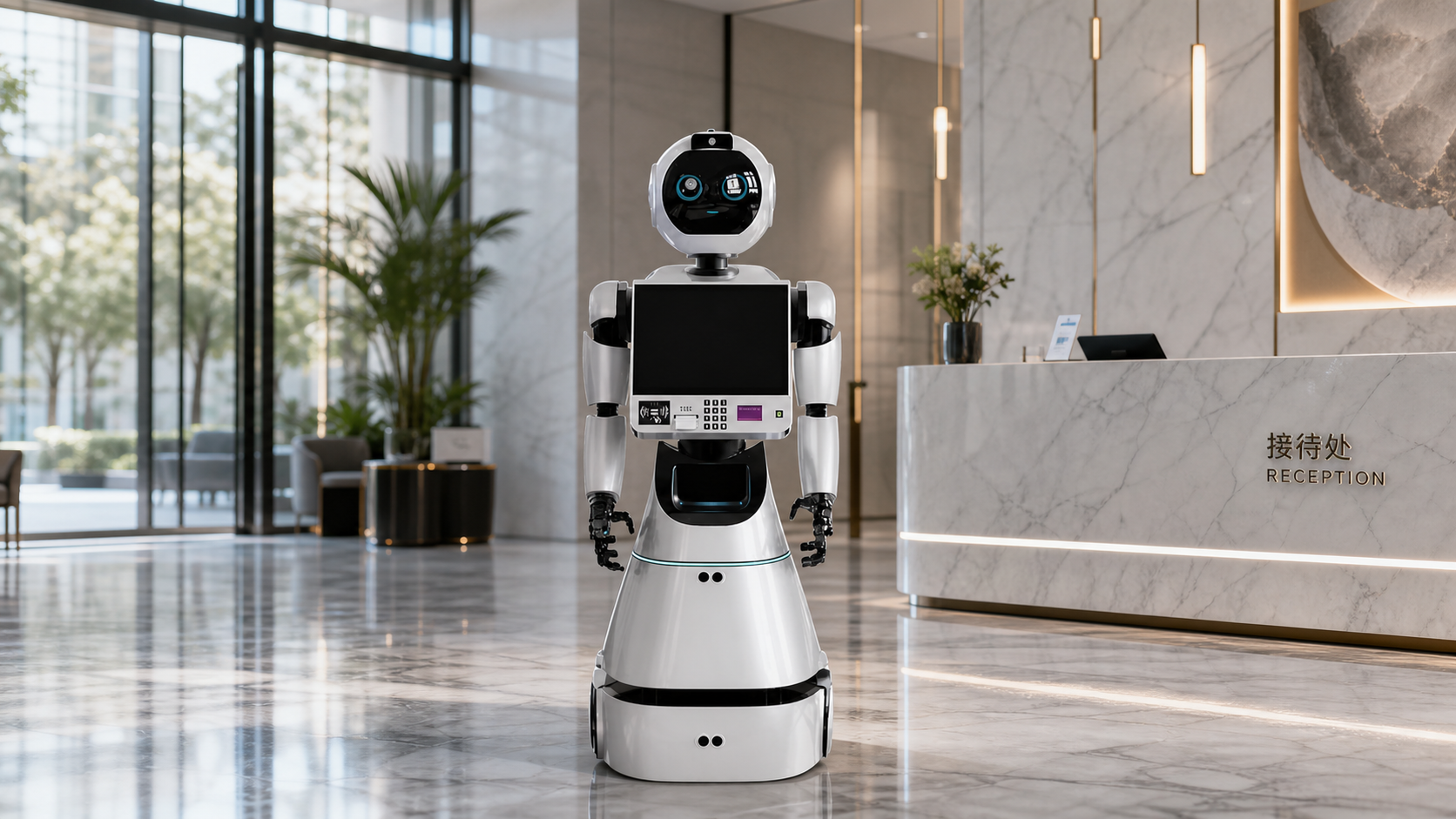
Reception robots are often first introduced to businesses as a way to greet visitors and provide basic information.
However, as deployment becomes more widespread, organizations are beginning to recognize a much broader value: reception robots are not just front-desk tools, but integrated platforms for visitor management, operational automation, and customer experience enhancement.
By combining robotics capabilities with large language models such as ChatGPT and Claude AI, modern reception robots can support end-to-end front desk operations while reducing manual workload and improving consistency of service.
This shift is redefining how businesses think about reception, from a human-dependent function to a partially automated, data-driven system.
The Evolution of Reception Robots in Enterprise Environments
In traditional settings, reception is a highly manual workflow involving visitor check-in, identity confirmation, internal notifications, wayfinding assistance, and occasional customer support.
Each of these steps requires staff attention, especially in high-traffic environments such as office buildings, hospitals, exhibition centers, and hotels.
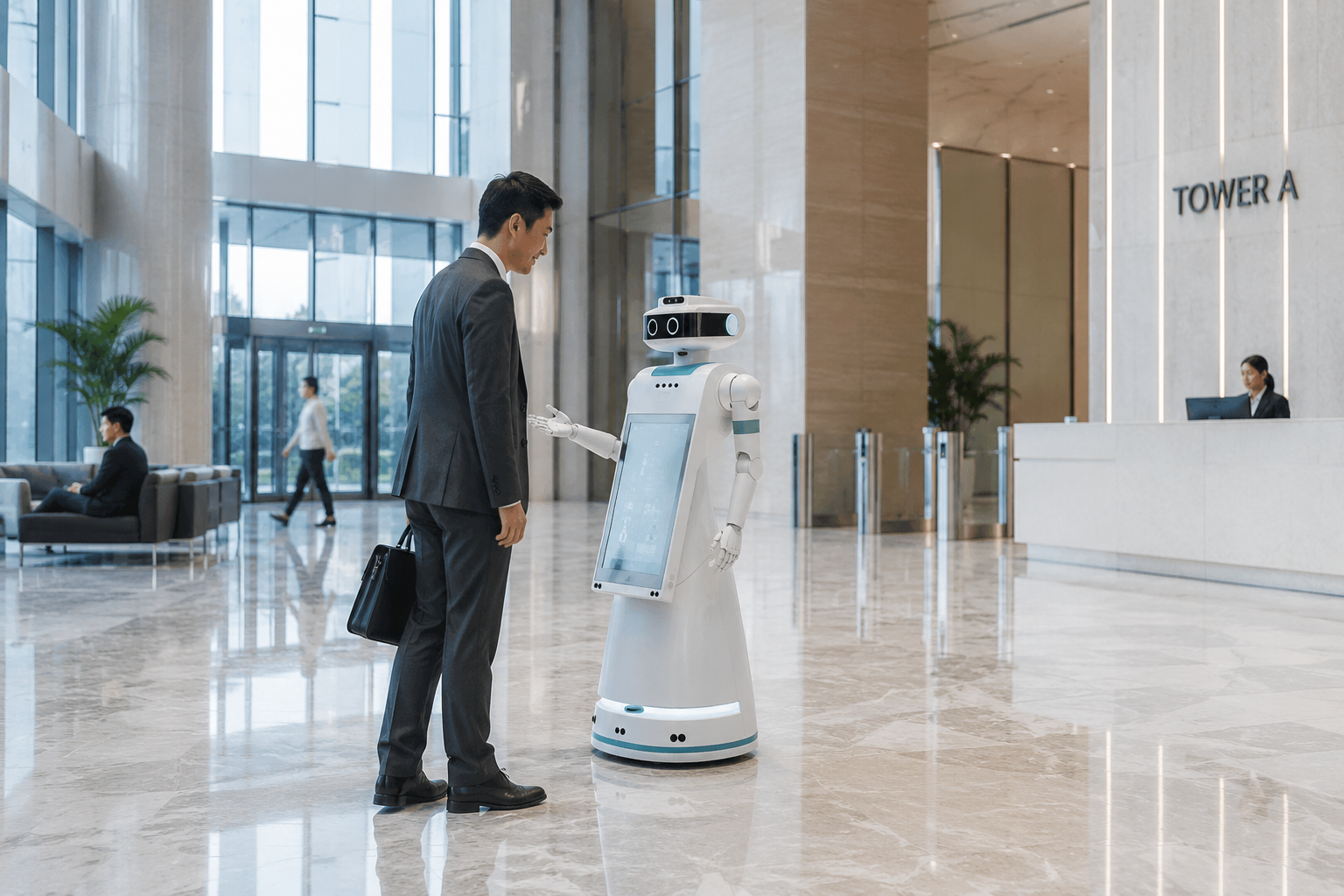
Modern AI-powered reception robots are increasingly taking over these repetitive and structured processes. Instead of replacing human interaction entirely, they function as an operational layer between visitors and staff, handling routine tasks while escalating complex requests when necessary.
As a result, reception robots are now being evaluated not only as customer-facing devices, but as infrastructure for operational efficiency.
AI-powered reception robot use cases
Visitor Registration as an Automated Entry System
One of the most immediate applications of reception robots is the automation of visitor registration.
When a guest arrives, the robot can handle the entire check-in workflow through a structured yet conversational interaction. Visitors are guided through identity input, contact details, purpose of visit, and host selection in a seamless flow.
In many deployments, the robot also captures a visitor image and automatically notifies the relevant employee through internal communication channels such as email, SMS, or messaging platforms.
This eliminates the need for manual logbooks or front desk intervention and significantly reduces waiting time during peak hours.
From a business perspective, this creates a more controlled and traceable visitor entry system while improving the overall arrival experience.
Improving Wayfinding in Complex Building Environments
Large buildings often present a navigation challenge for first-time visitors, especially in corporate campuses, hospitals, and exhibition venues where multiple departments or zones are distributed across different floors or buildings.
Reception robots equipped with autonomous navigation capabilities can guide visitors directly to their destination without requiring staff assistance.
Instead of asking for directions or relying on static signage, visitors receive step-by-step guidance in real time. In some environments, the robot may even escort guests physically to meeting rooms or service areas.
This reduces interruptions to employees while ensuring visitors can move efficiently through the facility, which is particularly important in high-volume environments.
Turning Visitor Feedback Into Structured Operational Data
Customer feedback is essential for improving service quality, but traditional collection methods are often inconsistent and underutilized.
Reception robots introduce a more structured approach by requesting feedback immediately after an interaction while the experience is still fresh in the visitor’s mind.
The feedback process is typically simple and conversational, allowing users to provide ratings and comments without navigating forms or surveys.
Once collected, this data is centralized and can be analyzed to identify patterns in visitor satisfaction, service bottlenecks, or operational inefficiencies.
For management teams, this transforms reception from a purely service function into a source of actionable business intelligence.
Using Idle Time for Business Communication and Promotion
In most environments, reception robots are not continuously engaged with visitors. This idle time creates an opportunity for secondary business functions.
Rather than remaining inactive, robots can display brand messaging, promotional content, or event-related information when not interacting with guests.
In retail spaces, exhibition booths, and corporate lobbies, this creates an additional communication channel that operates continuously throughout the day.
Some deployments also integrate QR-based interactions, allowing visitors to access promotions, digital catalogs, or membership programs directly from the robot interface.
This turns the reception robot into a dual-purpose asset, functioning both as a service interface and a communication platform.
Personalization Through Visitor Recognition Systems
As reception robots become more advanced, personalization is emerging as an important feature in improving visitor experience.
With appropriate consent and compliance frameworks in place, systems can recognize returning visitors and adapt greetings accordingly.
Rather than a generic welcome message, returning guests can be acknowledged in a more personalized way that reflects prior interactions.
This creates a sense of continuity and familiarity, which is particularly valuable in hospitality, corporate environments, and membership-based facilities.
At the same time, enterprises must ensure strict data governance policies are implemented to maintain transparency and compliance with privacy regulations such as GDPR.
Enhancing Safety Through Automated Emergency Response
Reception robots can also contribute to building safety and incident response workflows.
In the event of emergencies or when visitors request assistance, robots can trigger predefined response protocols, including alerting security teams, notifying designated contacts, and providing real-time location information.
Some systems may also capture relevant contextual data to support incident reporting and post-event analysis.
While not replacing dedicated security infrastructure, reception robots act as an additional layer of responsiveness, particularly in large or complex facilities.
Centralized Management for Scalable Deployments
As organizations expand robot deployment across multiple locations, centralized management becomes essential.
Modern platforms allow administrators to monitor device status, update content, manage workflows, and deploy software updates remotely.
This ensures consistency across all locations while reducing the operational overhead of managing each device individually.
For enterprises operating across multiple sites, this centralized approach significantly improves scalability and long-term maintainability.
Privacy, Compliance, and Enterprise Readiness
As with any AI-enabled system that interacts with users, privacy and compliance are critical considerations.
Enterprise-grade reception robot systems increasingly include features such as privacy modes that allow users to disable audio or visual capture when needed.
In addition, data collection is typically designed to follow regulatory frameworks requiring user consent and transparent usage policies.
Some deployments also support local data storage options to address stricter security requirements in sensitive environments.
These considerations are essential for ensuring long-term adoption in regulated industries such as healthcare, finance, and government services.
Measuring Business Value and Operational ROI
The adoption of reception robots is ultimately driven by measurable business outcomes.
Organizations evaluate performance across multiple dimensions, including reduced front desk workload, improved visitor throughput, enhanced customer satisfaction, and increased efficiency in communication workflows.
In many cases, reception robots contribute value across multiple departments simultaneously, including operations, marketing, security, and customer service.
Rather than being treated as a standalone technology investment, they are increasingly viewed as part of broader digital transformation initiatives.
Conclusion
Reception robots are evolving from simple interactive kiosks into integrated enterprise systems that support visitor management, communication, security, and operational intelligence.
As AI capabilities continue to advance, particularly through large language models such as ChatGPT and Claude AI, these systems are expected to play an increasingly important role in how organizations manage physical spaces and human interaction.
For enterprises seeking to improve efficiency while maintaining high-quality visitor experiences, reception robots are becoming a strategic infrastructure layer rather than an experimental technology.
Contact Experts from Xyserrobotics to get a local deployment solution for AI reception robots.
Read the previous blog: AI-Powered Reception Robots: 8 Customer Service Use Cases Powered by ChatGPT and Claude AI