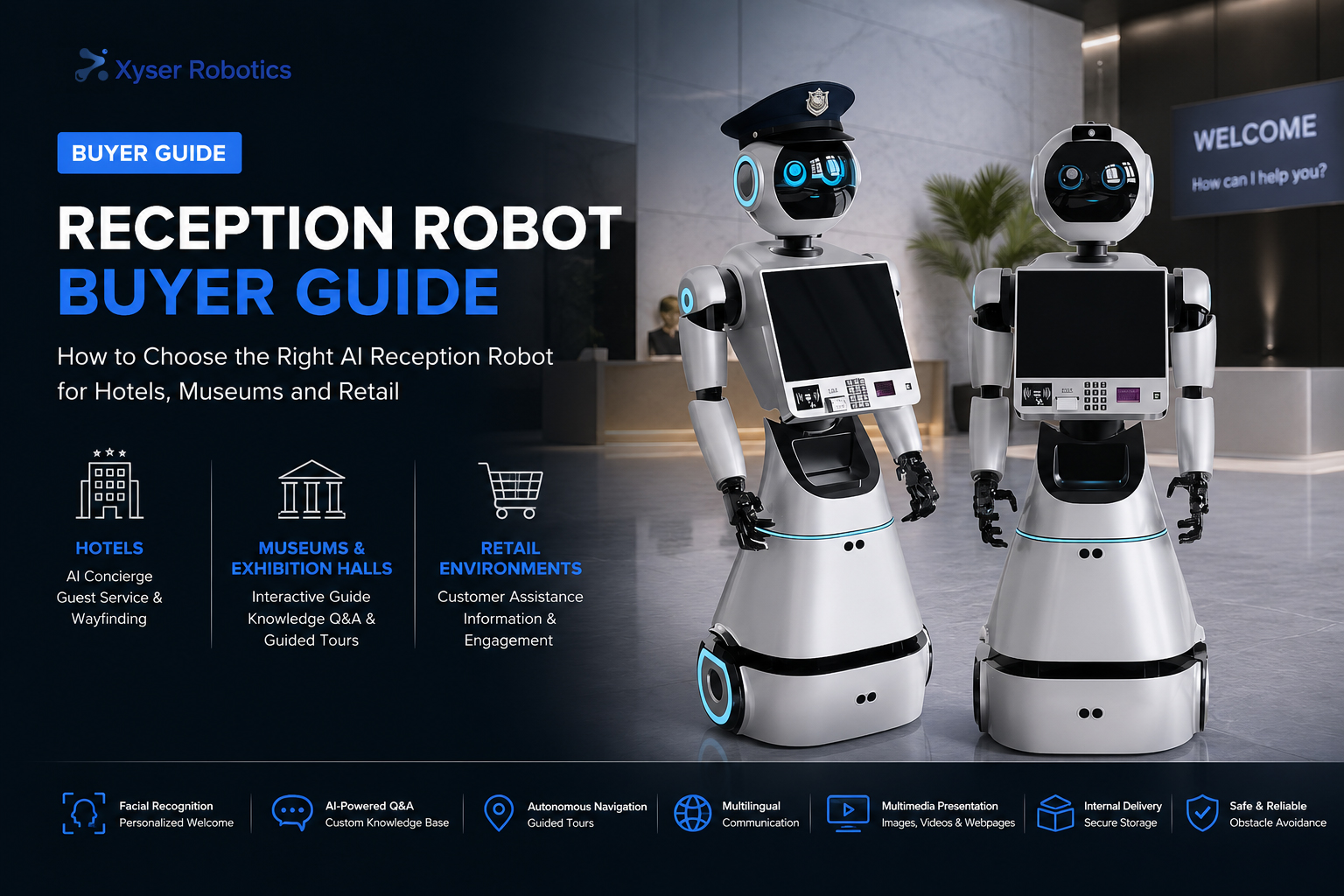
Reception robots are becoming increasingly common in hotels, museums, exhibition halls, supermarkets and other public-facing environments. But choosing the right reception robot is not simply a matter of comparing hardware specifications or counting how many features a robot has.
Different environments create very different requirements.
A hotel may need an AI concierge that welcomes guests, answers questions and guides visitors to different facilities. A museum or exhibition hall may need an interactive digital guide that can explain exhibition themes and answer visitors' questions. A supermarket or shopping mall may prioritize customer guidance, information assistance and mobile engagement in a busy public environment.
For this reason, the best reception robot is not necessarily the one with the most functions. It is the one whose AI capabilities, interaction design, navigation system and customization options match the actual visitor journey.
This guide explains what businesses should consider when choosing a reception robot for hotels, museums, exhibition halls and retail environments, and how to determine which capabilities matter most for each application.
Reception Robots for Hotels: More Than a Traditional Front Desk
Hotels have a particularly strong use case for reception robots because the first interaction with a guest can influence the entire customer experience.
A hotel reception robot should do more than simply greet visitors. It should be able to provide information, answer common questions, guide guests around the property and support the hotel's service team.
Guests may ask where the restaurant is, when breakfast starts, how to find a meeting room or where the swimming pool is located. Instead of requiring staff to answer the same questions repeatedly, an AI reception robot can provide immediate assistance through conversational interaction.
This makes AI conversation and knowledge-base customization important purchasing criteria for hotels. The robot should be capable of understanding questions and providing answers based on the hotel's own information rather than relying only on generic AI responses.
Popbot X1 supports integration with AI models such as ChatGPT and DeepSeek and allows businesses to create customized Q&A knowledge bases. Hotels can build their own information around facilities, services, opening hours and frequently asked questions, while enriching responses with images, videos and webpages.
Wayfinding is another important requirement in hotel environments. A robot that simply tells guests where to go provides limited value. A more capable system can actually escort visitors to a destination.
Popbot X1 supports voice-commanded navigation to preset locations and can autonomously return to its base after completing a task. This allows the robot to function more like a digital concierge than a static information kiosk.
Hotels can also use the robot for personalized interactions. Popbot X1 supports facial recognition and customized voice greetings, allowing different greeting messages to be triggered for recognized visitors or first-time guests.
For hotels, therefore, the most important reception robot capabilities are personalized guest interaction, AI-powered Q&A, multilingual communication, wayfinding and service assistance.
The goal is not simply to automate the front desk. It is to create a more responsive and intelligent guest experience while reducing repetitive work for hotel staff.
Reception Robots for Museums and Exhibition Halls: Interactive Digital Guides
Museums, science and technology museums, history exhibition halls, government exhibition halls and cultural exhibition centers have a completely different reception requirement.
In these environments, the robot is not primarily a sales assistant. Its role is to become an interactive digital guide that helps visitors understand the exhibition.
Visitors may want to know what a particular exhibit represents, why a historical event was important, how a technology works or what they should visit next. A traditional information board can provide fixed information, but it cannot respond to individual questions or adapt the explanation to different visitors.
An AI-powered reception robot can make the exhibition experience more interactive.
The robot can introduce the overall theme of an exhibition, explain individual exhibits, answer visitor questions and provide additional information based on the visitor's interests. This is particularly valuable in museums and science centers where visitors may include children, families, students, tourists and international visitors with very different levels of knowledge.
For this type of application, customized knowledge management becomes one of the most important purchasing criteria.
Every museum or exhibition hall has its own content, terminology and educational objectives. A suitable reception robot therefore needs to support a customized knowledge base rather than providing only generic AI conversation.
Popbot X1 allows organizations to create customized Q&A content and enrich responses with images, videos and webpages. This provides a foundation for building an AI guide around a specific museum, exhibition theme or public education program.
Navigation is also important in large exhibition spaces.
Instead of simply telling visitors that a particular exhibition is located on the other side of the building, the robot can guide them to designated locations. Popbot X1 supports multi-point navigation and guided tours, allowing different destinations and presentation content to be configured for the visitor experience.
For museums and exhibition halls, the value of a reception robot therefore lies in its ability to combine visitor reception, interactive explanation, AI Q&A, exhibition guidance and multimedia presentation.
The robot does not need to replace a professional human guide. Instead, it can act as an additional digital guide that provides consistent information and engages visitors during busy periods.
This makes reception robots particularly suitable for museums, science centers, history exhibition halls, government exhibition spaces and other public venues where education and visitor engagement are more important than sales.
Reception Robots for Supermarkets: Customer Assistance in High-Traffic Environments
Retail environments create another set of requirements.
Supermarkets, hypermarkets and shopping malls typically have high visitor traffic, constantly changing customer flows and large indoor spaces. The robot therefore needs to interact with customers while navigating safely around people, shopping carts, displays and other obstacles.
In these environments, a reception robot should not be viewed simply as a stationary information desk.
It can become a mobile customer assistance platform, providing information and guidance wherever visitors need it.
For example, customers may want to know where a particular department is located, where customer service can be found or how to reach a specific area of the store. A mobile robot can provide information and guide customers through the environment instead of requiring them to locate a fixed information counter.
Navigation and obstacle avoidance are therefore particularly important in retail environments. The robot must be able to detect obstacles and adjust its route when people or objects enter its path.
Popbot X1 combines LiDAR, vision and bumper-based obstacle detection to identify obstacles in real time. When its route is blocked, it can reroute or wait before continuing, which is particularly relevant for crowded indoor environments such as retail stores and shopping malls.
Retailers should also consider how much the robot's content can be customized.
Instead of displaying the same generic information everywhere, businesses can configure presentation content around store information, customer assistance and other communication needs. Popbot X1 supports customizable presentation content and can incorporate images, videos and webpages into its knowledge-based responses.
The reference buyer guide you provided also highlights an important point for supermarket deployments: the physical environment matters as much as the software. Buyers need to consider traffic density, available navigation space, aisle layouts, operating hours, language requirements and privacy considerations before deploying a reception robot.
For retail environments, the purchasing priority therefore shifts toward navigation, customer interaction, information assistance, content management and safe operation in crowded public spaces.
What Should You Look for When Choosing a Reception Robot?
Although hotels, museums and retail environments have different priorities, several core capabilities should be evaluated across all applications.
AI Conversation and Knowledge Customization
The first question is whether the robot can actually understand and respond to visitors naturally.
A reception robot becomes significantly more useful when its conversational AI can be connected to a customized knowledge base. This allows a hotel to build a digital concierge, a museum to build an exhibition guide and a retailer to create a customer assistance system.
The ability to customize the knowledge base is therefore often more important than simply asking which AI model the robot uses.
Visitor Recognition and Personalized Interaction
Personalization can make robotic interaction feel much more natural.
Facial recognition and customized voice greetings can allow the robot to recognize specific visitors or trigger different greetings based on predefined conditions. Popbot X1 supports facial recognition and personalized voice greetings, as well as expressive head and arm movements designed to create more natural interactions.
For hotels, this can support personalized guest greetings. In public exhibitions, it can create a more engaging welcome experience. In retail, it can help attract attention and initiate customer interaction.
Navigation and Visitor Guidance
A reception robot should not be limited to standing at a fixed location.
For larger facilities, autonomous navigation allows the robot to escort visitors between different destinations and participate in guided tours.
Popbot X1 supports multi-point navigation and can guide visitors to preset destinations before returning autonomously to its base.
When evaluating a robot, buyers should therefore consider not only whether it can navigate autonomously, but also whether its routes, destinations and visitor interaction points can be customized for the facility.
Multilingual Communication
Hotels, museums, shopping malls and other public venues often serve visitors from different countries and language backgrounds.
A reception robot with multilingual communication capabilities can make information and guidance more accessible while reducing the need for staff to repeat basic information.
Popbot X1 uses a cloud-based dual-language speech engine that can switch between Chinese and English, making it suitable for bilingual reception and visitor interaction scenarios.
For international deployments, buyers should evaluate language support according to the actual visitor demographics of the facility rather than assuming that every robot's language capabilities will meet their requirements.
Safety and Navigation in Public Spaces
Public-facing robots operate around people, so navigation safety is a fundamental requirement.
Hotels have guests with luggage. Museums have families and children. Shopping malls have dense and constantly changing pedestrian traffic.
The robot should be capable of detecting obstacles, adjusting its route and stopping or waiting when necessary.
Popbot X1 combines LiDAR, vision and bumper sensors for real-time obstacle detection and can reroute or wait when its path is blocked. It can also automatically return to charge and resume its scheduled operation.
Customization and System Integration
A reception robot should also fit into the existing digital environment of the organization.
Hotels may need integration with internal service systems. Museums may need customized exhibition content. Retailers may require integration with existing customer service or information systems.
Popbot X1 provides Windows and Android protocols, a full SDK and sample code, allowing developers to create customized behaviors and integrate systems such as elevators, POS systems and proprietary CRMs.
This becomes particularly important for organizations planning a long-term deployment rather than a short-term demonstration.
Popbot X1: An AI Reception Robot for Multiple Commercial Environments
Popbot X1 is designed as an indoor reception robot that combines intelligent conversation, personalized interaction, autonomous navigation and customized content presentation.
Its capabilities allow the same robotic platform to serve different purposes depending on the deployment environment.
In hotels, Popbot X1 can function as a digital concierge, greeting guests, answering questions and guiding visitors around the property.
In museums and exhibition halls, it can become an interactive digital guide, explaining exhibition themes, answering visitor questions and guiding visitors through different areas.
In supermarkets and shopping malls, it can act as a mobile customer assistance platform, helping visitors find destinations, providing information and engaging customers in busy public spaces.
The platform also supports customized presentation content, AI-powered Q&A, facial recognition, personalized greetings, multilingual communication and secure internal storage for light delivery tasks.
This flexibility is important because reception robotics is not a one-size-fits-all application. The same hardware platform can deliver very different value depending on how its AI, content, navigation and interaction capabilities are configured.
Conclusion: Choose a Reception Robot Based on the Visitor Journey
Choosing a reception robot should start with the environment, not the product specification sheet.
A hotel needs a robot that can improve guest service and act as a digital concierge. A museum or exhibition hall needs an interactive guide that can communicate knowledge and engage visitors. A supermarket or shopping mall needs a mobile customer assistance solution that can operate safely in a high-traffic environment.
The right reception robot is therefore not necessarily the robot with the longest feature list. It is the robot that can perform the right tasks in the right environment and adapt to the way visitors actually interact with the facility.
If you are looking for a reception robot for a hotel, museum, science center, exhibition hall, supermarket or shopping mall, contact the Xyser Robotics team to discuss your application requirements and develop a customized reception robot solution for your facility. From AI knowledge-base development and visitor interaction to autonomous navigation and system integration, we can help design a solution around your specific visitor journey.
Learn more about Xybot X1:
https://www.xyserrobotics.com/productdetail/popbot-x1
7 Advanced Reception Robot Features That Improve Visitor Management and Business Efficiency
AI-Powered Reception Robots: 8 Customer Service Use Cases Powered by ChatGPT and Claude AI